The Business Credit and Debt Handbook
Finance · Nº 54
The Business Credit and Debt Handbook
Working Capital, Loans, and Renegotiation, without Deciding on the Spot at the Bank
Your overdraft line has been maxed out for months. That's not an emergency anymore.
24 tools, a debt map spreadsheet, and one brick and tile plant followed from the first list of debts to the exit plan, so you know what you owe, what it costs, and what to sign.
You get 24 tools to map every debt, measure the all-in cost and the installment the business can afford, compare credit offers, renegotiate before you fall behind, and plan your way out with a date. Plus a spreadsheet with 5 tabs, filled in with the example.
A book explains the method. This handbook puts it to work: the tool, a worked example, and a spreadsheet with your numbers.
One-time payment of $29.00. The order form shows the final amount, with any taxes for your country, before you pay.
Digital delivery: PDF handbook, spreadsheet and access on the Consylion platform.
14-day money-back guarantee: if it isn't what you expected, request a full refund within 14 days of purchase.
Your order is processed by Digistore24, our authorized reseller. By purchasing, you accept the terms of use and purchase · refund policy.
There's a working capital loan at one bank and a financed machine at another. The overdraft line is always in use. There's a credit card, a supplier you're behind on, and an old bill on a payment plan. If someone asked what the business owes in total, or what it pays in interest each month, you'd have to go look. Meanwhile the account manager calls with a new offer, and you sign in a hurry because the installment looks small.
THE SPREADSHEET
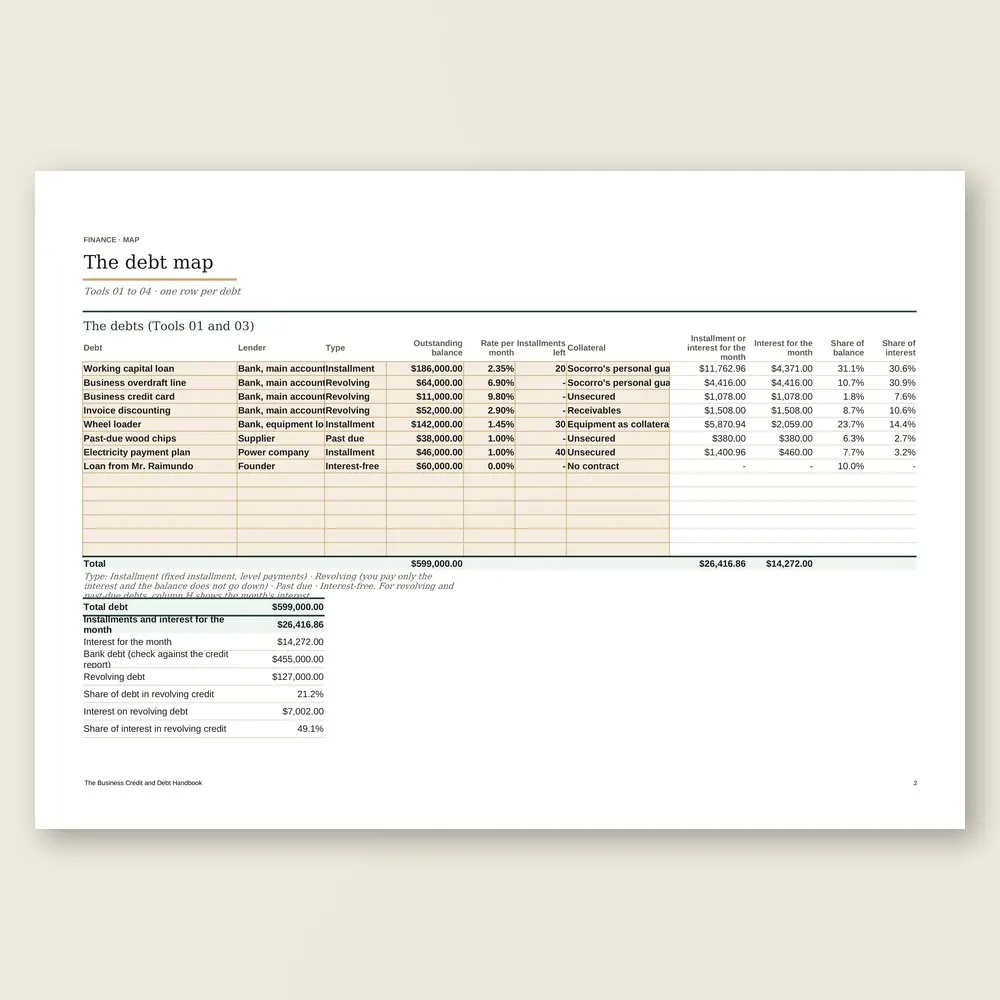
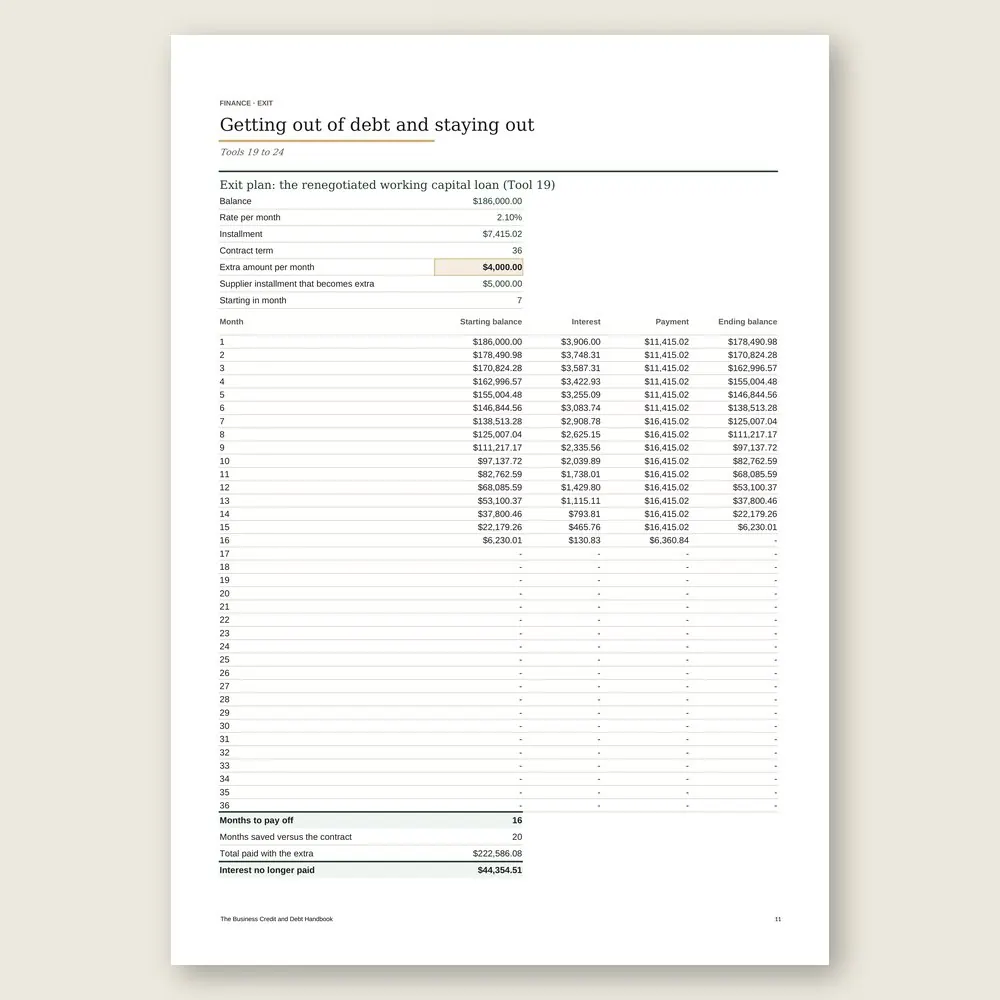
Debt map spreadsheet
Use the completed example as a reference and enter your business data in the marked fields. Check the instructions and the calculations before you make a decision.
SOUND FAMILIAR?
Three situations this handbook solves
The account manager calls with a new offer
You don't decide on the phone. You ask for the offer in writing with the all-in cost, get a second one from another lender, and put both in the same table: cost, term, installment, and collateral. Then you decide.
The month's cash doesn't cover everything
You follow the payment order: wages and the month's fixed bills first, then the inputs that keep you running, then the debts. Before the installment comes due, you call the bank with the math in hand and ask to fold it into a renegotiation.
Closing the month
You open the debt dashboard and check four numbers, each with its signal. If the overdraft line ran more than 10 days last month, the borrowing policy already says what happens next.
INSIDE
What you'll find in each tool
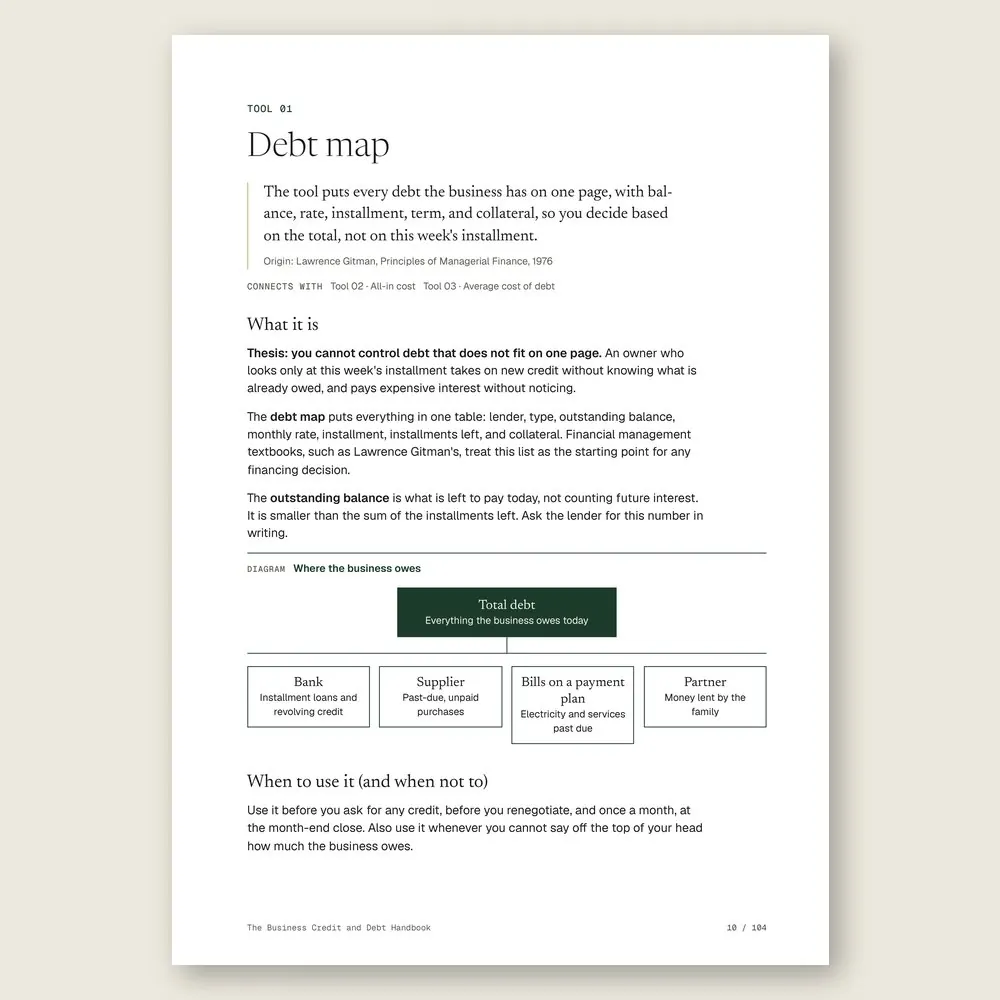
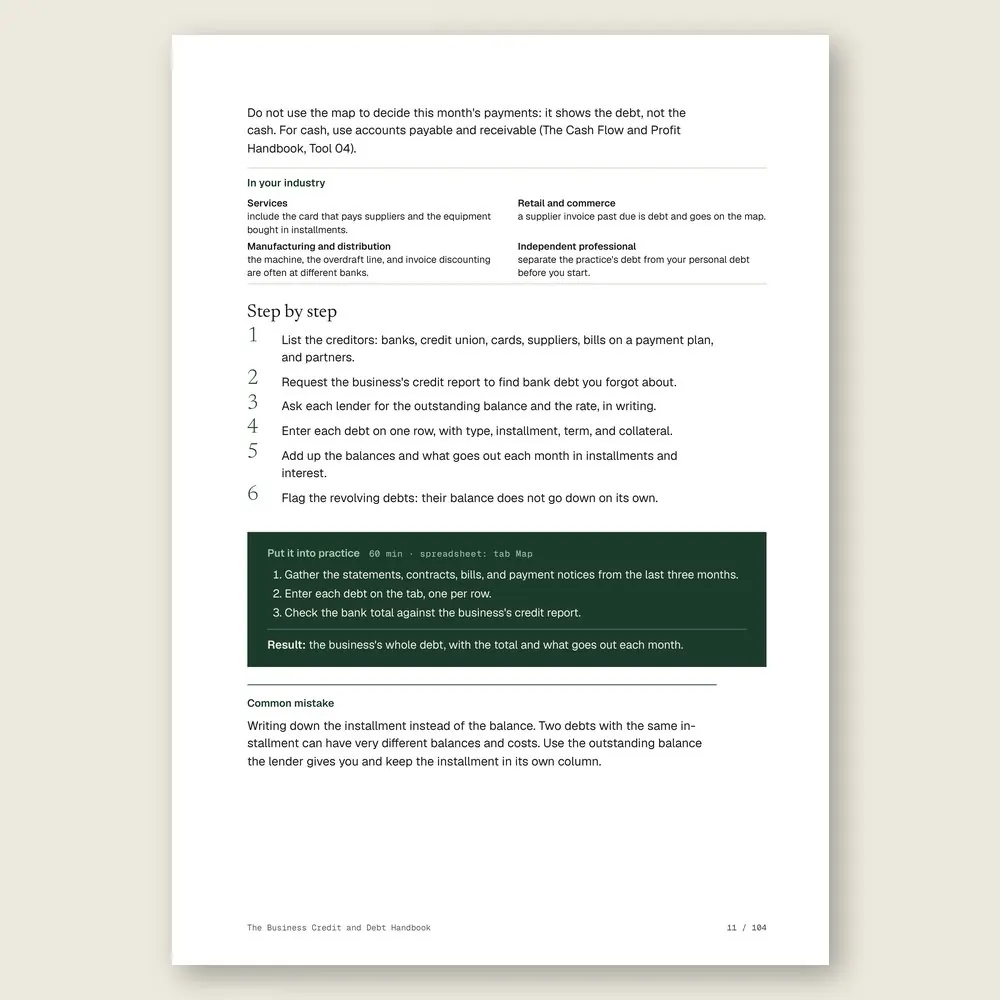
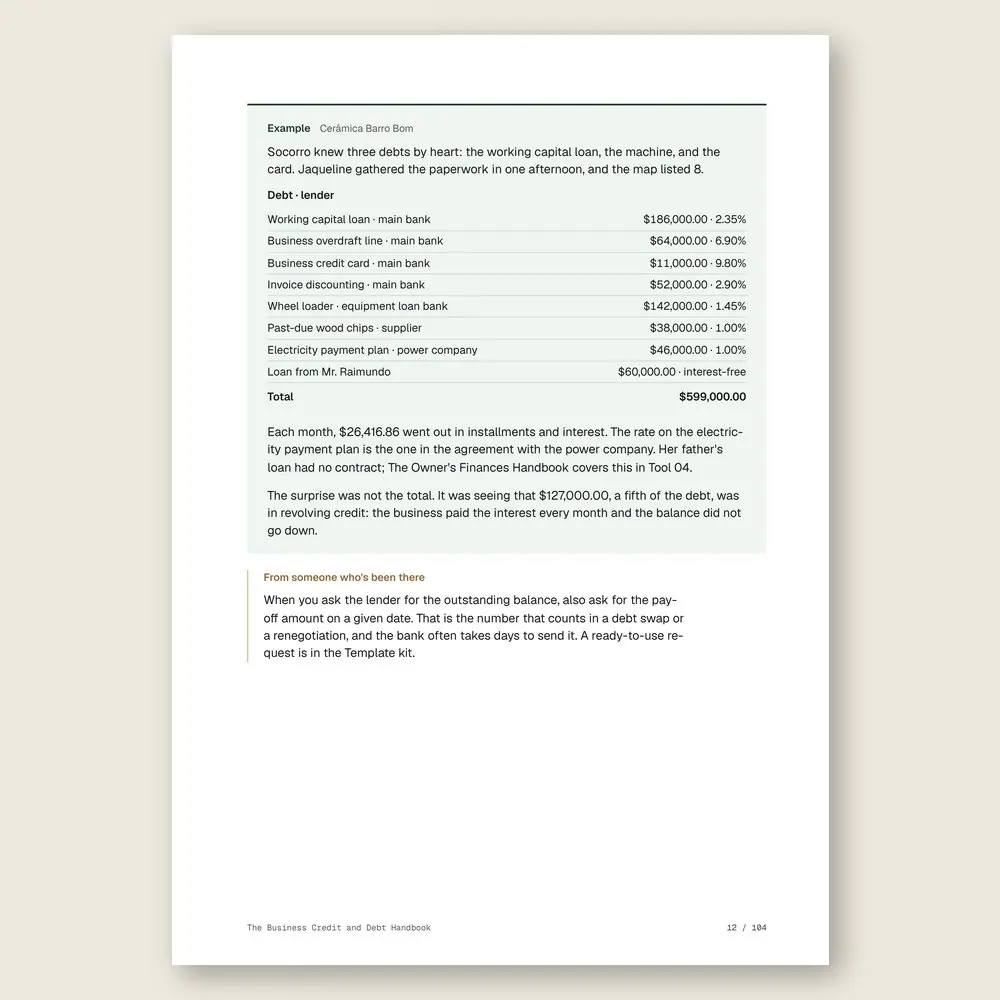
Five parts, in the order you'll need them. Put every debt on one page with its real cost. Learn what each kind of credit is for and when it turns into a trap. Ask for credit with your file ready and compare offers side by side. Renegotiate with the bank and your suppliers before you fall behind. Then plan your exit, write a borrowing policy, and know when to call for help. Every tool has a step by step, a worked example, and an exercise.
WHAT YOU GET
Everything included in your purchase
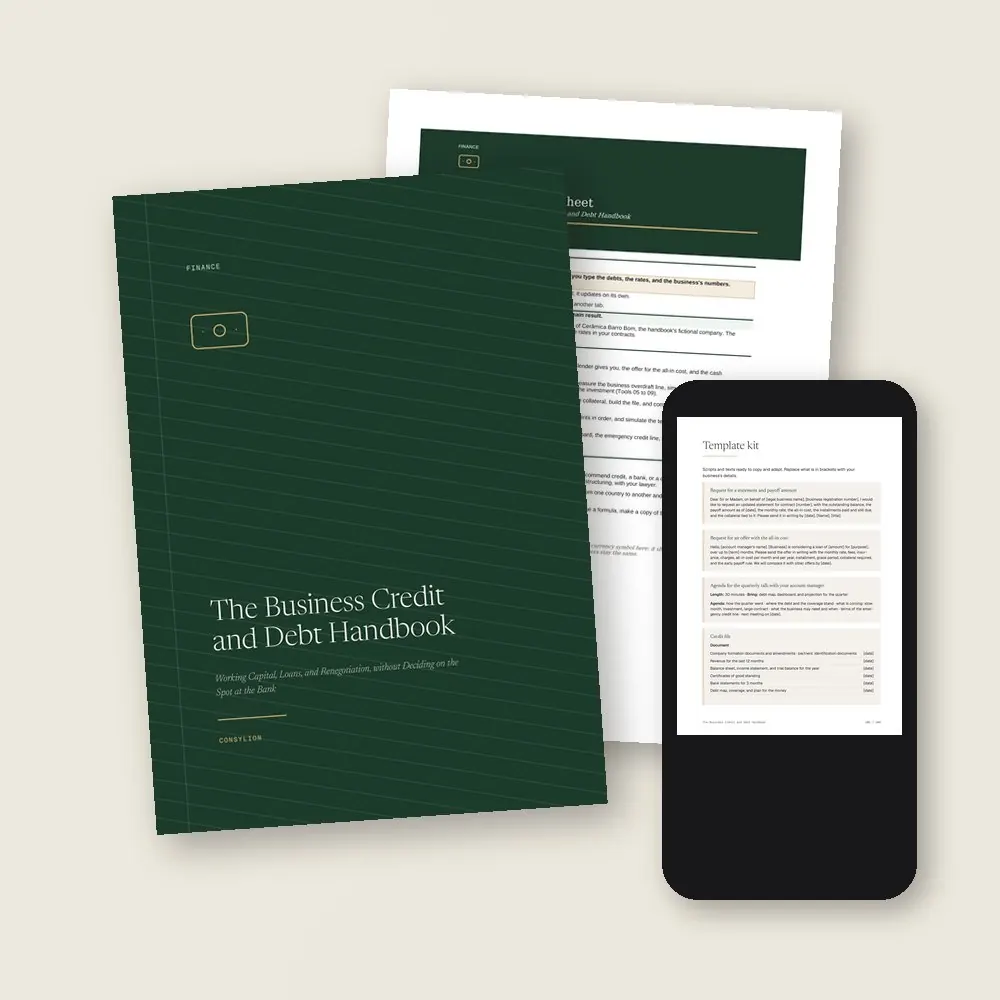
- The Business Credit and Debt Handbook in PDF: 24 tools, each with a step by step, a worked example, and an exercise
- The Debt map spreadsheet in Excel and Google Sheets, with 5 tabs (Map, Credit options, Request, Renegotiation, and Exit), filled in with the example company
- The Template kit: 12 ready-to-adapt texts, including the offer request with the all-in cost, the renegotiation request, and the borrowing policy
- 2 worksheets to fill in (single debt and offer comparison) and a 30-day plan, one week per stage
- Access to your handbook on the Consylion platform
Full table of contents
The 24 tools, in the order you'll use them
Part 1 · Part 1 · The full picture of your debt
- 01Debt mapEvery debt on one page, with balance, installment, rate, term, and collateral
- 02All-in costThe real price of a loan, with fees, insurance, and charges added to the interest
- 03Average cost of debtThe rate the business pays on average, and the debt that drags the average up
- 04How much the business can afford to payThe installment that fits the cash the operation generates, with room for the slow month
Part 2 · Part 2 · The credit options
- 05The order of funding sourcesYour own cash, suppliers, banks, or partners: which money to tap first
- 06Overdraft and business overdraft lineHow emergency credit turns into permanent debt, and how to get out of it
- 07Installment working capital loansWhen a working capital loan fixes the crunch and when it only postpones it
- 08Credit lines with public guaranteesPrograms backed by public funds or associations: who they're for and what they require
- 09Credit for investmentFinance only the machine that pays its own installment, with the return worked out first
Part 3 · Part 3 · Asking for credit the right way
- 10What the bank looks atThe five criteria of credit analysis, and the record you can check before they do
- 11Business collateralWhat each kind of collateral ties up, what's at risk, and what not to offer
- 12The account manager and the credit fileBuild the relationship before you need it and keep the documents ready
- 13Comparing offersTwo or three offers in the same table: all-in cost, term, installment, and collateral
Part 4 · Part 4 · Renegotiating
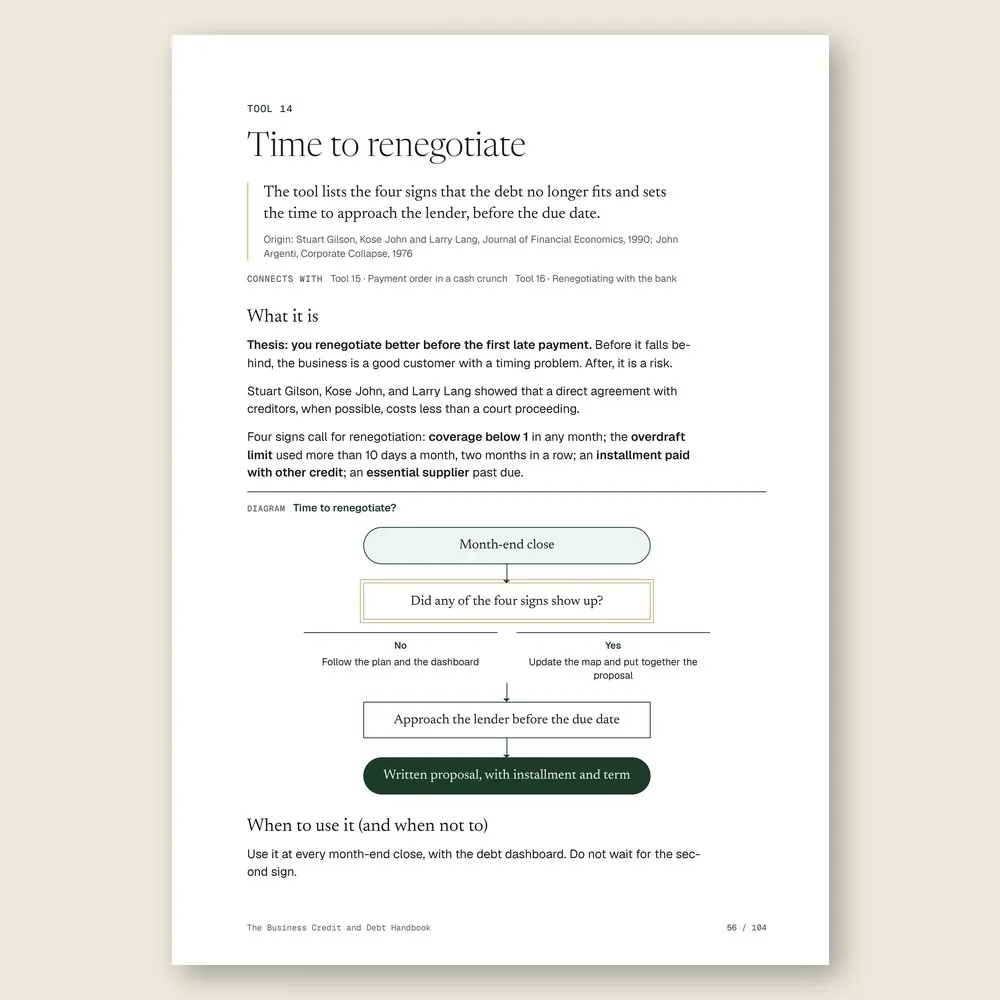
- 14Time to renegotiateThe signs that the debt no longer fits, spotted before the first late payment
- 15Payment order in a cash crunchWhat to pay first when the month's money doesn't cover everything
- 16Renegotiating with the bankExtending, a grace period, or consolidating: the options and what each one costs
- 17Swapping out expensive debtPay off the costliest debt with cheaper credit, without growing the total
- 18Supplier payment agreementPast-due supplier debt in installments, without losing your supply
Part 5 · Part 5 · Getting out of debt and staying out
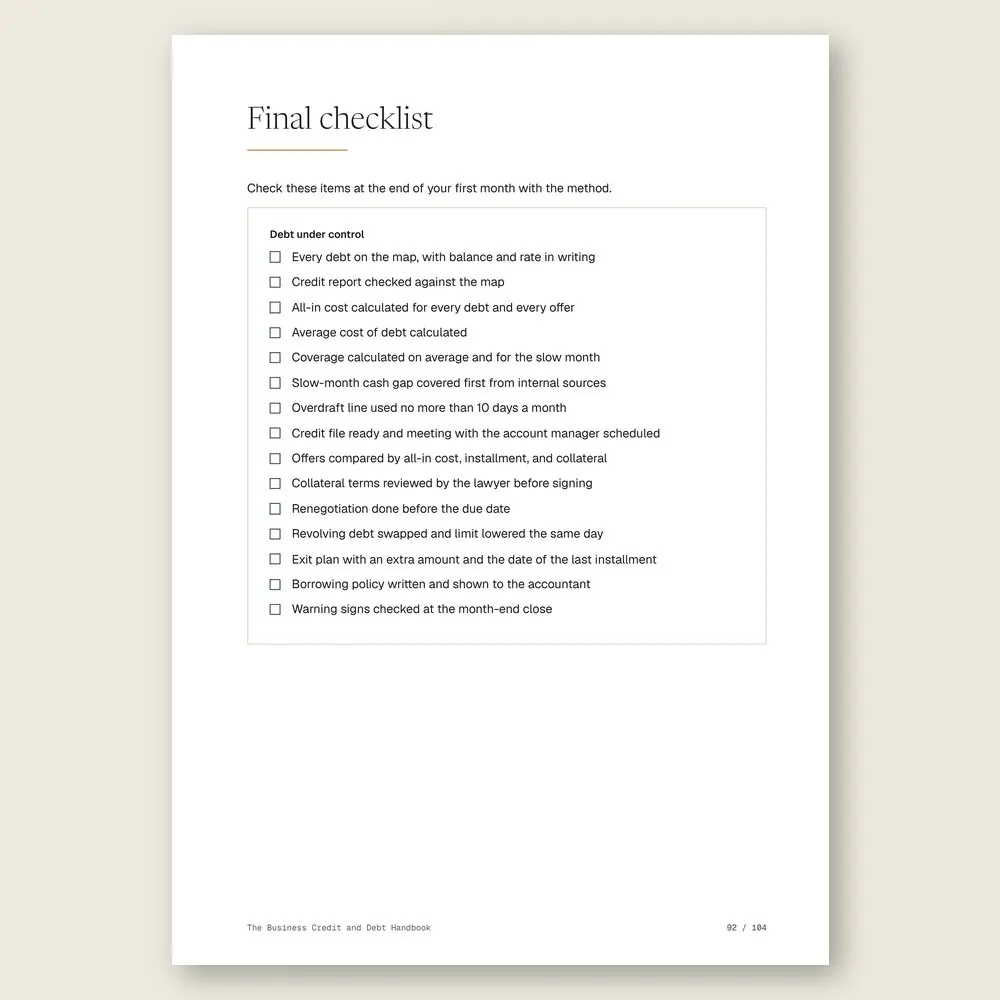
- 19Debt exit planThe payoff order, the extra each month, and the date of the last installment
- 20Debt dashboardFour numbers to check every month, each with its own warning signal
- 21Emergency credit lineCredit approved before you need it, with a rule for using it and a deadline to pay it back
- 22Business borrowing policyWritten rules for when, how much, and how the business may borrow
- 23Signs it is time to ask for helpThe warnings that call for an accountant, a lawyer, or a consultant while there's still time
- 24Formal debt restructuringWhat it is, when it applies, and why it isn't the first step
Who it's for
It's for you if
- You owe banks, suppliers, or other creditors, and you couldn't say the total or the monthly cost right now
- The overdraft line or the business credit card has quietly become everyday money
- You're about to take out a loan or finance a machine and want to compare offers before you sign
- The installments are starting to pinch and you want to renegotiate before the first late payment
It's not for you if
- You need to build your cash flow and work out how much working capital you need. Start with The Cash Flow and Profit Handbook
- Your personal debts and the line between home and business come first. That's The Owner's Finances Handbook
- You want negotiation technique for any situation, not just debt. That's The Negotiation Handbook
- You want someone to tell you which bank or credit line to pick. This handbook teaches you to measure and compare, not to recommend
Frequently asked questions
My business has no bank debt. Is this for me?
It is. A past-due supplier invoice, a credit card, a bill on a payment plan, and a loan from a family member are debt too. Start with the debt map and the installment the business can afford (Tools 01 and 04).
The account manager says it's the best rate on the market. How do I check?
Ask for the offer in writing with the all-in cost, fees and insurance included, and get a second offer from another lender. Then compare them in the same table (Tools 02 and 13).
I've already fallen behind. Is it too late to renegotiate?
No, but you'll have fewer options. Go to the lender before the next installment, with the debt map and the installment that fits your slowest month (Tools 14 and 16).
Should I put up my home as collateral?
Not as your first offer. The handbook ranks collateral from what ties up the least to what ties up the most, with real estate last, and has you offer the lightest one the bank accepts. Any contract with collateral goes to your lawyer before you sign (Tool 11).
Does it tell me which bank or credit line to use?
No. Credit rules and programs change from country to country and from year to year. The handbook teaches you to measure, compare, and decide, and tells you what to run by your accountant and your lawyer before you sign.
Do I need to know finance?
No. It's written for owners, beginner to intermediate. All-in cost, coverage, and level payments are explained in plain English, and the spreadsheet does the math. About 2 hours and 24 minutes of reading, or 6 minutes per tool.
What do I get, and in what formats?
Each handbook is a PDF of about 100 pages with 24 to 27 tools. Every tool has step-by-step instructions and a worked example. You also get the handbook's spreadsheet in Excel (.xlsx), which opens in Google Sheets too, with the example already filled in. The message, policy, and clause templates are in the Template Kit inside the PDF, ready to copy and adapt. Read it in the member area or download the files.
How do I know if it fits my business?
Each handbook's page shows the problem it solves, who it is for and who it is not for, the full table of contents, sample pages, and the company used in the examples. The examples come from small businesses in several industries, with illustrative numbers. If it is not a fit, you can ask for a full refund within 14 days of your purchase, as described in the Refund Policy.
What is the difference between a handbook, an area set, and the Series?
A handbook solves one problem. An area set brings together every handbook and spreadsheet in one of the 6 areas, for less than the price of 5 single handbooks. The Consylion Handbook Series brings together all 100 handbooks and 100 spreadsheets, for less than the price of 8 single handbooks, and includes the next handbooks in the Series. Products outside the Series, from Consylion Life or Consylion Business, have their own price. They are sold separately and are not part of an area set or the Series.
Do I need to read everything before I start?
No. Each tool works on its own. Open the table of contents, pick the tool for today's problem, and start there. You can also read it cover to cover.
Do I need to know Excel?
The basics are enough: open the file and fill in the marked fields. The formulas are already built, and the handbook's example is filled in for reference.
How do I pay, and when do I get access?
By card or bank transfer, as a one-time payment with no subscription. Once your payment is confirmed, you get access to the member area by email. Approved card payments are confirmed right away. Bank transfers are confirmed when the funds clear. If access does not arrive within 24 hours of confirmation, check your spam folder and write to team@consylion.org.
How long do I have access, and how can I use the files?
Access does not expire, and you can download the files for offline use. The license is individual. You may read the handbooks, print them for your own use, and fill in and adapt the spreadsheet and templates with your company's data. If you are a consultant, accountant, or manager, you may apply the tools with your clients and deliver the result of your work, not the files. You may not share, resell, or distribute the files or the access.
How do support and refunds work?
Support is by email at team@consylion.org, on business days, with a reply within 5 business days. It covers questions about access, files, and payment. It does not include consulting or advice on applying the material to your case. You can cancel within 14 days of your purchase, without giving a reason, and get the full amount back through the payment method you used. Send the request to the same email. The details are in the Refund Policy.

CONSYLION HANDBOOK SERIES
The 6 departments of your business, for less than the price of 8 single handbooks.
This handbook solves today's problem. The Series solves the next one, and the one after that, with nothing more to pay.
- 100 handbooks with 2,403 ready-made tools, to read on screen and download as PDFs
- 100 spreadsheets for Excel and Google Sheets
- 6 business areas
- Lifetime access, unlocked once payment is confirmed
One-time payment of $197.00. The order form shows the final amount, with any taxes for your country, before you pay.
Digital delivery: PDF handbook, spreadsheet and access on the Consylion platform.
14-day money-back guarantee: if it isn't what you expected, request a full refund within 14 days of purchase.
Your order is processed by Digistore24, our authorized reseller. By purchasing, you accept the terms of use and purchase · refund policy.
Finance · Nº 54
Know what you owe before you sign again
Credit used well buys the machine and gets you through the slow month. Used badly, it eats the profit in interest. This handbook gives you the tools, the spreadsheet, and a worked example to see every debt on one page, compare before you sign, and put a date on the last installment.
See all 100 handbooks · $197.00
One-time payment of $29.00. The order form shows the final amount, with any taxes for your country, before you pay.
Digital delivery: PDF handbook, spreadsheet and access on the Consylion platform.
14-day money-back guarantee: if it isn't what you expected, request a full refund within 14 days of purchase.
Your order is processed by Digistore24, our authorized reseller. By purchasing, you accept the terms of use and purchase · refund policy.