The Collections and Late Payments Handbook
Finance · Nº 53
The Collections and Late Payments Handbook
Get Paid on Time and Collect Overdue Bills without Losing the Customer
Your customers love buying on credit. Paying on time, not so much.
24 tools, a spreadsheet that does the math, and one electrical supply store followed from the first credit application to the last resort, so you know who gets credit, when to call, and what to say.
You get 24 tools to decide who buys on credit, put the terms in writing, run a collections sequence by channel, handle the call and the payment agreement, and use the last resort at the right time. Plus a spreadsheet with 8 tabs, filled in with the example.
A book explains the method. This handbook puts it to work: the tool, a worked example, and a spreadsheet with your numbers.
One-time payment of $29.00. The order form shows the final amount, with any taxes for your country, before you pay.
Digital delivery: PDF handbook, spreadsheet and access on the Consylion platform.
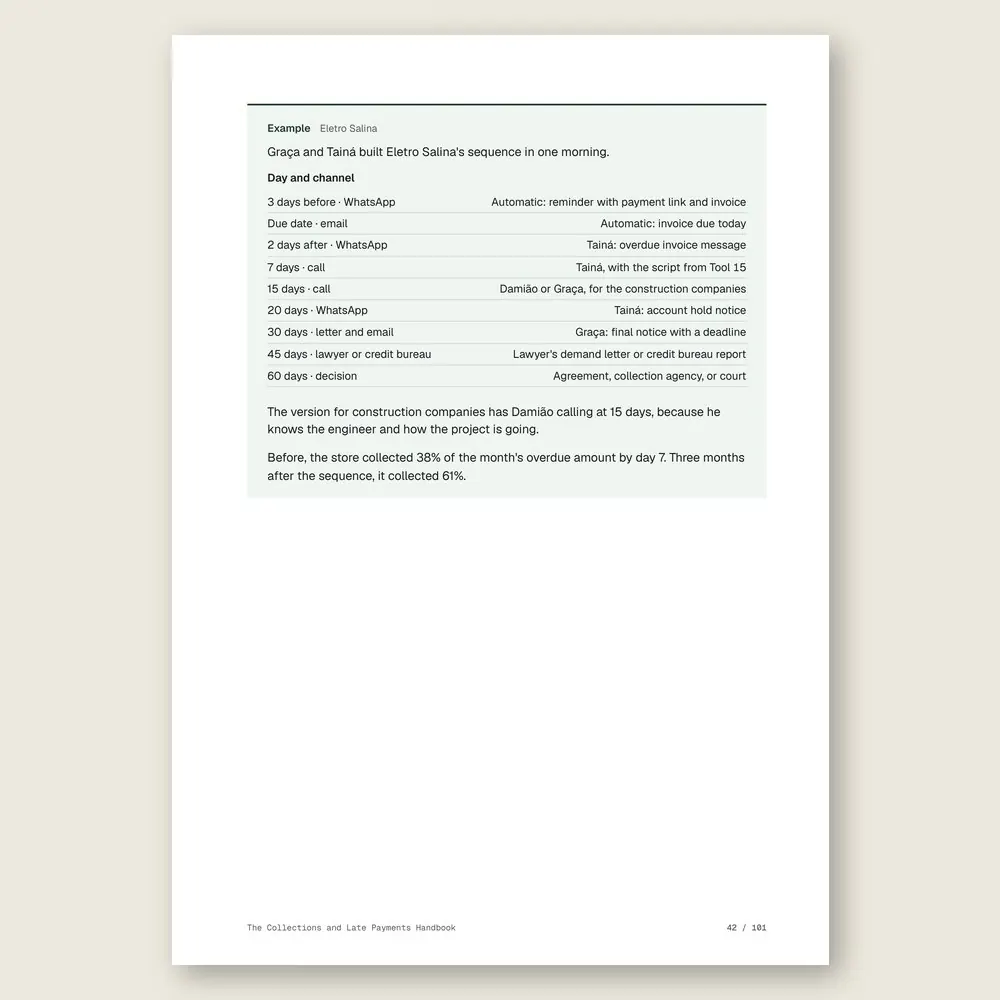
14-day money-back guarantee: if it isn't what you expected, request a full refund within 14 days of purchase.
Your order is processed by Digistore24, our authorized reseller. By purchasing, you accept the terms of use and purchase · refund policy.
The invoice was due on the 10th. It's the 28th. Nobody has called, because the customer has bought from you for years and calling feels rude. Credit gets approved by whoever is at the counter, each with their own rule, and a lot of accounts have no application on file. When someone finally does call, the bill is three months late, everyone's annoyed, and you lose the money and the customer in the same conversation.
THE SPREADSHEET
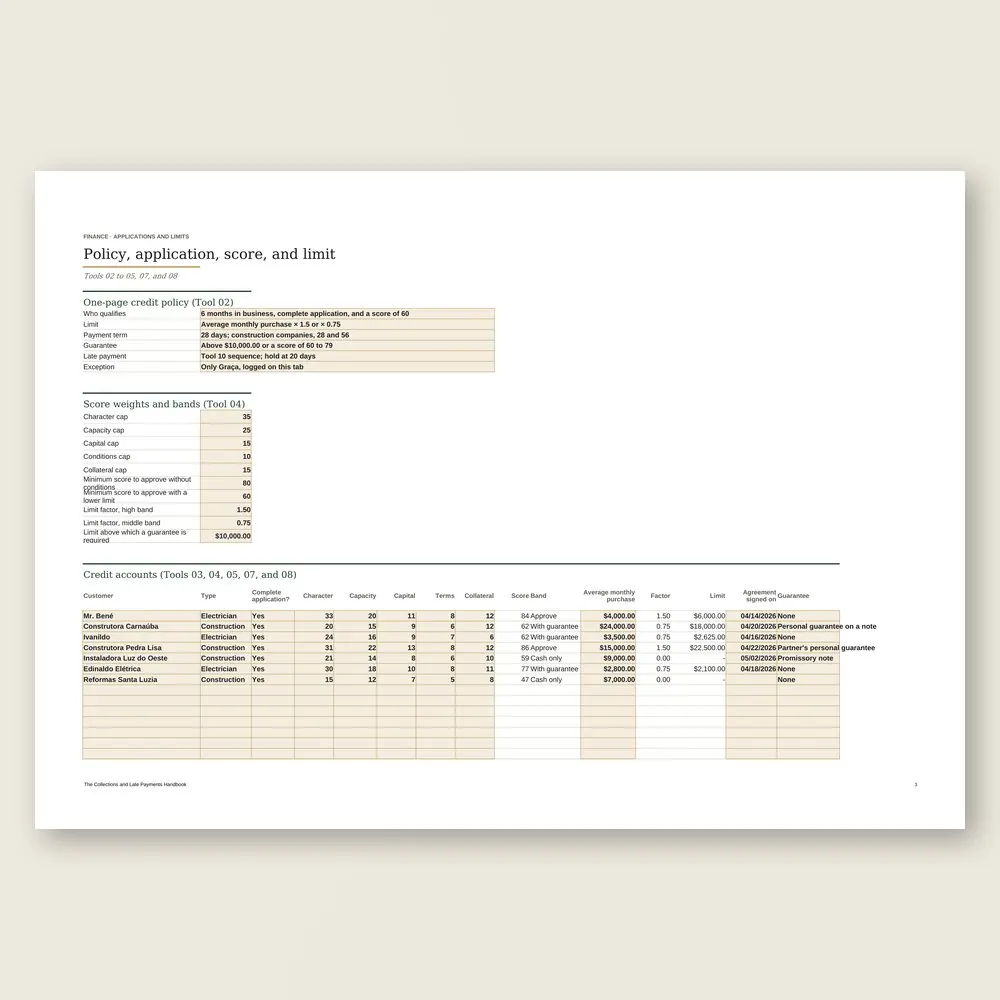
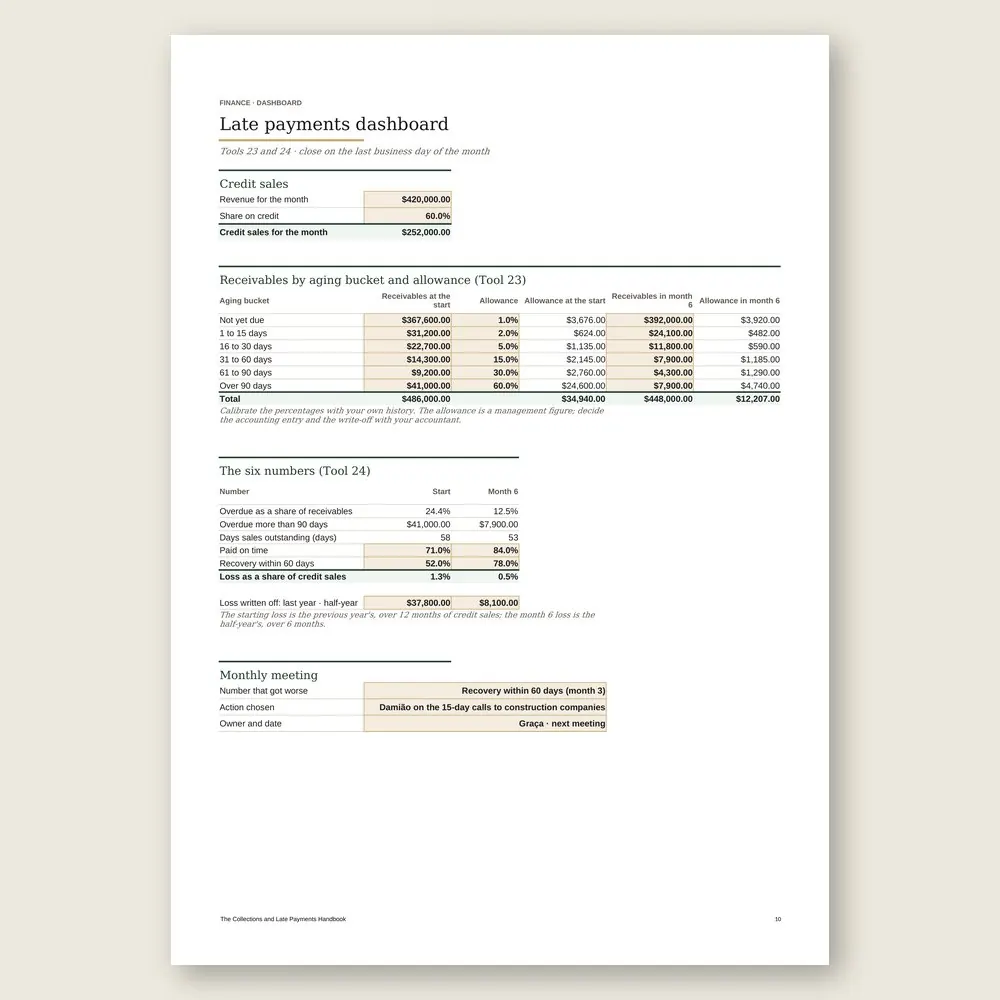
Credit and Collections spreadsheet
Use the completed example as a reference and enter your business data in the marked fields. Check the instructions and the calculations before you make a decision.
SOUND FAMILIAR?
Three situations this handbook solves
Three days before the due date
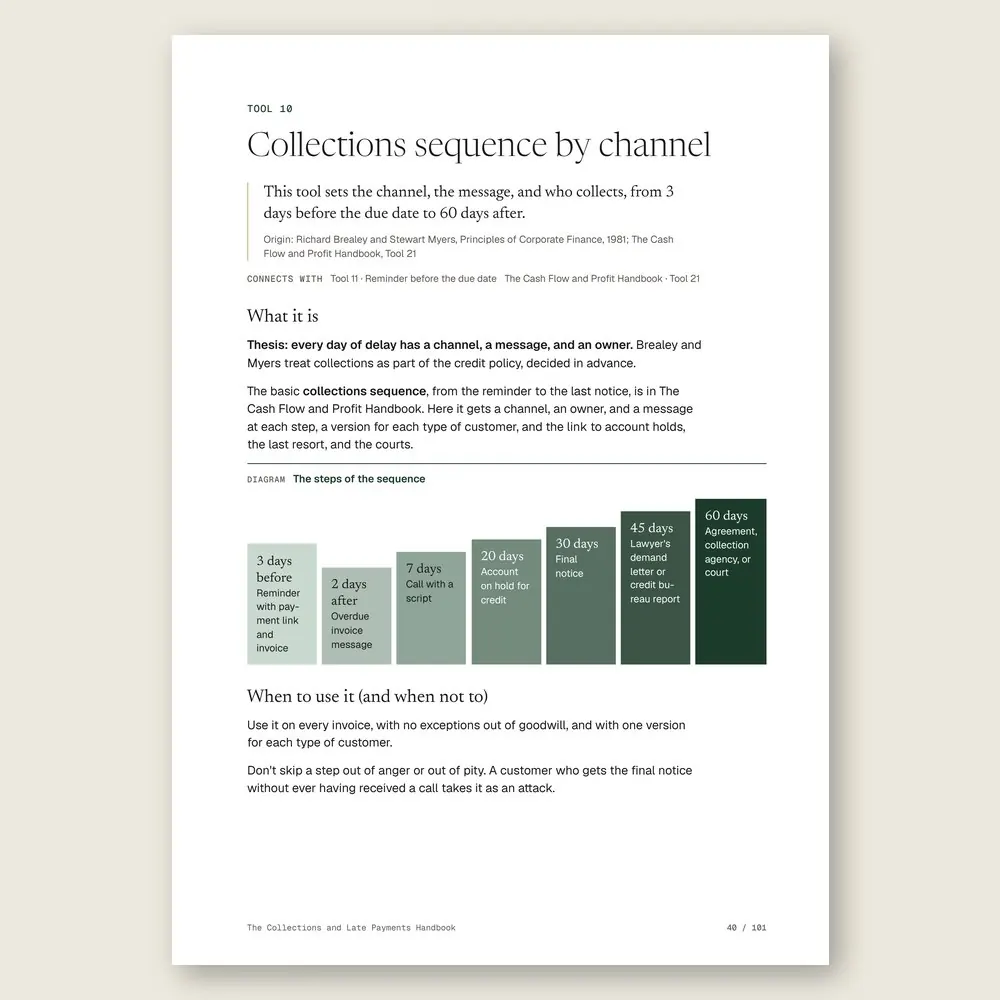
The reminder goes out with the payment link and the invoice attached. Four lines, starting with the customer's name. The customer who simply lost track of the date hears from you while the money's still in their account.
A new builder wants a big order on long terms
Before you say yes, you run the break-even math, check the application, and score the account from 0 to 100. The answer comes with a starting limit, a ladder for raising it, and a co-signer or a promissory note if your policy calls for one.
The customer says "next week"
You don't write that down. You follow the call script, sum up what you heard, and ask for a day, an amount, and a method. Then you send a two-line confirmation and set a reminder for the day before.
INSIDE
What you'll find in each tool
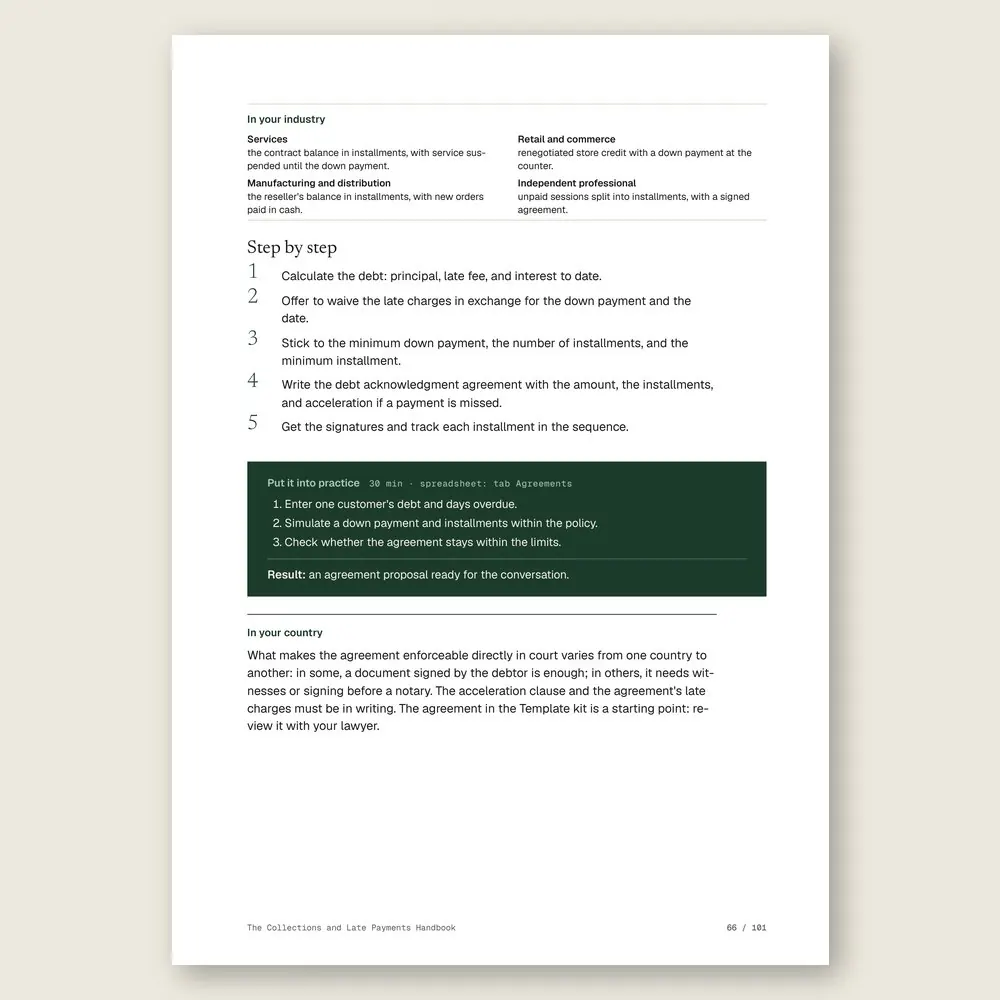
Five parts, in the order the money moves. Decide who buys on credit and how much. Put the terms, the backing, and the proof of delivery in writing. Build the collections sequence, from the reminder before the due date to the final notice. Handle the call, the excuses, and the payment agreement. Then the last resort, the bad debt allowance, and a six-number dashboard. Every tool has a step by step, a worked example, and an exercise.
WHAT YOU GET
Everything included in your purchase
- The Collections and Late Payments Handbook in PDF: 24 tools, each with a step by step, a worked example, and an exercise
- The Credit and Collections spreadsheet in Excel and Google Sheets, with 8 tabs, filled in with the example company
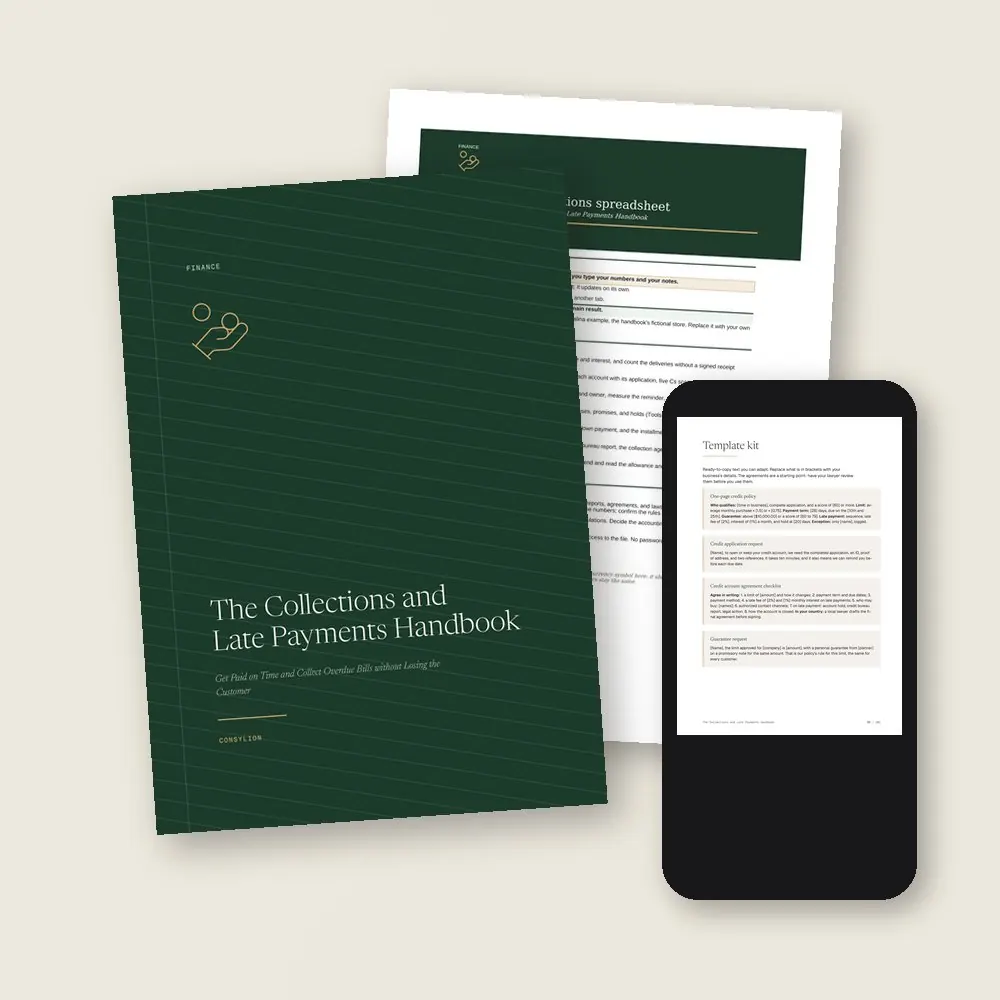
- The Template kit: 15 ready-to-adapt texts, from the one-page credit policy to the collection call script and the debt acknowledgment checklist
- 2 worksheets to fill in (customer credit application and collection call) and a 30-day plan, one week per stage
- Access to your handbook on the Consylion platform
Full table of contents
The 24 tools, in the order you'll use them
Part 1 · Part 1 · Who buys on credit
- 01The math of selling on creditFind the point where a credit sale stops making money, before you approve the order
- 02One-page credit policySix questions answered on one page, so every salesperson follows the same rule
- 03Customer credit applicationWhat to ask for before you open the account, in a form that takes ten minutes
- 04Credit check and analysisThe five Cs and a credit bureau check, turned into one score from 0 to 100
- 05Credit limitA starting limit for each account and a ladder for raising it as the customer pays
Part 2 · Part 2 · Contracts, security, and proof
- 06Credit account termsPayment terms, due dates, and late charges in writing before the first purchase
- 07Credit account agreementThe clauses the customer signs that back up every collection that follows
- 08GuaranteesCo-signers, a partner's backing, and promissory notes: when to ask, which kind, and how to ask without offending
- 09Proof of sale and deliverySigned receipts and an authorized buyers list, so nobody can say they never ordered it
Part 3 · Part 3 · The collections sequence
- 10Collections sequence by channelWho sends what, and through which channel, from 3 days before the due date to 60 days after
- 11Reminder before the due dateA four-line message that gets people to pay on time without feeling chased
- 12A collection message that gets you paidThe six elements of a message that's clear, firm, and polite
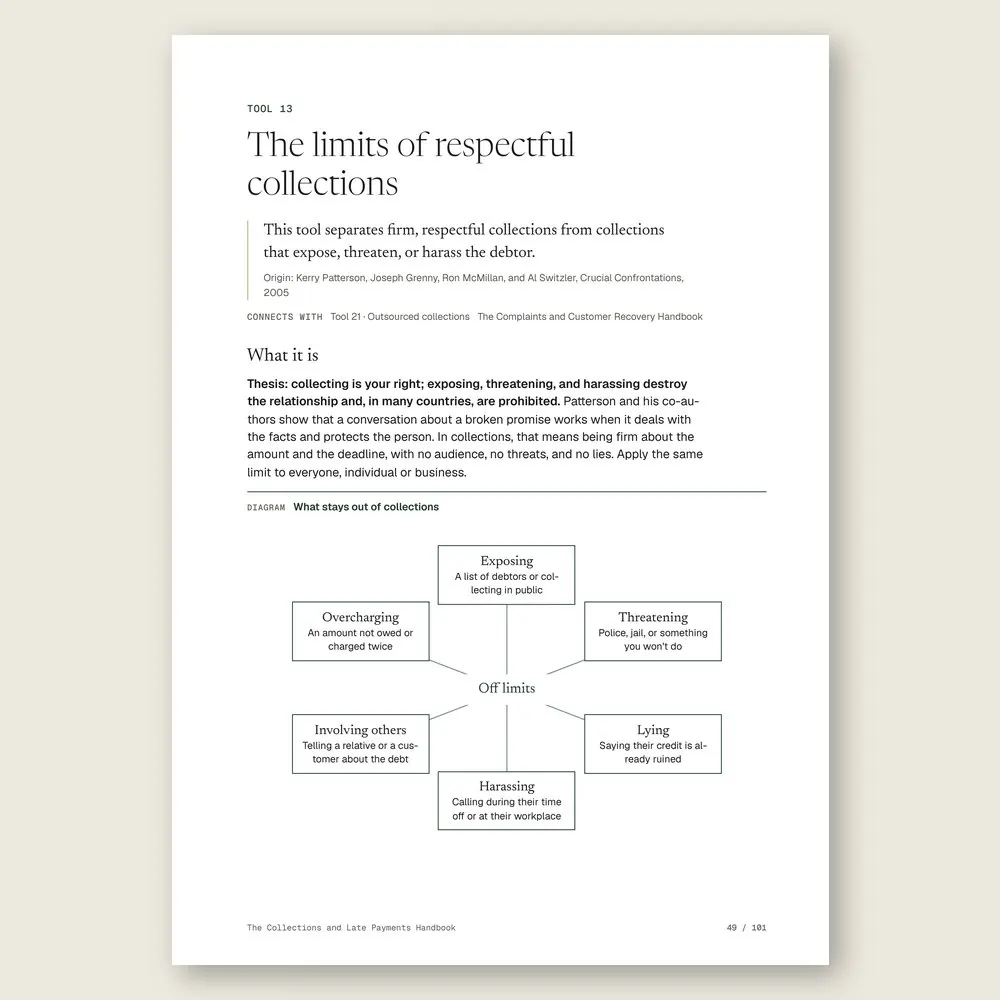
- 13The limits of respectful collectionsPublic exposure, threats, and calls at odd hours: what never belongs in collections
Part 4 · Part 4 · The conversation and the agreement
- 14Who to collect from firstA daily queue by amount and days overdue, so your time goes where the money is
- 15The collection callA six-step script for calling without embarrassing anyone and hanging up with a date
- 16Excuses and objectionsAnswers to the six things every debtor says
- 17A promise with a dateTurn "next week" into a day, an amount, and a payment method, confirmed in writing
- 18Payment agreements and installmentsDown payment, installments, and a signed acknowledgment, without giving up what's yours
- 19Account holds and reinstatementWhen to put the account on hold and how to bring the customer back on credit
Part 5 · Part 5 · Last resort and the numbers
- 20Demand letters and credit bureau reportingWhen to use each one, what it costs, and how to close it out once they pay
- 21Outsourced collectionsWhen to hand a debt to a collection agency and what to require in writing
- 22Collecting in small claims courtThe simplified path for a small debt, with your file in order
- 23Bad debt allowance and write-offsHow much to set aside each month and when to finally write a debt off
- 24Late payments dashboardSix numbers to check once a month, with one meeting to act on them
Who it's for
It's for you if
- You sell on credit, by invoice, store credit, or house account, and too much of it is overdue
- Credit gets approved on gut feeling, and you've already been burned by a customer who seemed solid
- You put off collection calls because you don't want to embarrass a long-time customer
- You want to collect firmly, in writing and on schedule, without crossing the line into threats or public shaming
It's not for you if
- You want to set up cash flow and track what customers owe you. Start with The Cash Flow and Profit Handbook
- You're the one who owes the bank or a supplier. That's The Business Credit and Debt Handbook
- You need legal advice on a specific debt. The handbook explains the method and leaves your case to your lawyer
- You want a promise of zero late payments. The handbook sets up the policy and shows you how to measure whether it works
Frequently asked questions
I don't sell much on credit. Do I need all of this?
No. Start with the one-page credit policy, the reminder before the due date, and the call script (Tools 02, 11, and 15). Add the rest as your receivables grow.
Can I charge late fees to a long-time customer who never signed anything?
Only what was agreed is safe to demand. The handbook shows you how to send the terms and the credit account agreement and apply late charges from then on. The local rule is one to confirm with your lawyer, and the handbook flags where (Tools 06 and 07).
Won't collecting cost me the customer?
Collecting late and in anger usually does. The handbook's approach is to be predictable: the customer knows the terms, gets a reminder before the due date, and hears from you on a set schedule, in a set tone. It also covers how to put an account on hold and bring the customer back (Tools 10 and 19).
Do I need to know accounting or law?
No. It's written for owners, beginner to intermediate, and the spreadsheet does the math. Where a rule changes from country to country, like late charges, credit bureau reporting, or small claims court, a box tells you what to check with your lawyer or accountant.
My customers are businesses, not consumers. Does it still apply?
Yes. The example store sells to individual electricians and to construction companies, and every tool shows how it applies to services, retail, manufacturing and distribution, and independent professionals. To be safe, the handbook has you collect from everyone within the same limits.
How much time does this take?
About 2 hours and 24 minutes of reading, or 6 minutes per tool, plus the exercises. The 30-day plan sets up one stage per week, and after that the dashboard takes one meeting a month.
What do I get, and in what formats?
Each handbook is a PDF of about 100 pages with 24 to 27 tools. Every tool has step-by-step instructions and a worked example. You also get the handbook's spreadsheet in Excel (.xlsx), which opens in Google Sheets too, with the example already filled in. The message, policy, and clause templates are in the Template Kit inside the PDF, ready to copy and adapt. Read it in the member area or download the files.
How do I know if it fits my business?
Each handbook's page shows the problem it solves, who it is for and who it is not for, the full table of contents, sample pages, and the company used in the examples. The examples come from small businesses in several industries, with illustrative numbers. If it is not a fit, you can ask for a full refund within 14 days of your purchase, as described in the Refund Policy.
What is the difference between a handbook, an area set, and the Series?
A handbook solves one problem. An area set brings together every handbook and spreadsheet in one of the 6 areas, for less than the price of 5 single handbooks. The Consylion Handbook Series brings together all 100 handbooks and 100 spreadsheets, for less than the price of 8 single handbooks, and includes the next handbooks in the Series. Products outside the Series, from Consylion Life or Consylion Business, have their own price. They are sold separately and are not part of an area set or the Series.
Do I need to read everything before I start?
No. Each tool works on its own. Open the table of contents, pick the tool for today's problem, and start there. You can also read it cover to cover.
Do I need to know Excel?
The basics are enough: open the file and fill in the marked fields. The formulas are already built, and the handbook's example is filled in for reference.
How do I pay, and when do I get access?
By card or bank transfer, as a one-time payment with no subscription. Once your payment is confirmed, you get access to the member area by email. Approved card payments are confirmed right away. Bank transfers are confirmed when the funds clear. If access does not arrive within 24 hours of confirmation, check your spam folder and write to team@consylion.org.
How long do I have access, and how can I use the files?
Access does not expire, and you can download the files for offline use. The license is individual. You may read the handbooks, print them for your own use, and fill in and adapt the spreadsheet and templates with your company's data. If you are a consultant, accountant, or manager, you may apply the tools with your clients and deliver the result of your work, not the files. You may not share, resell, or distribute the files or the access.
How do support and refunds work?
Support is by email at team@consylion.org, on business days, with a reply within 5 business days. It covers questions about access, files, and payment. It does not include consulting or advice on applying the material to your case. You can cancel within 14 days of your purchase, without giving a reason, and get the full amount back through the payment method you used. Send the request to the same email. The details are in the Refund Policy.
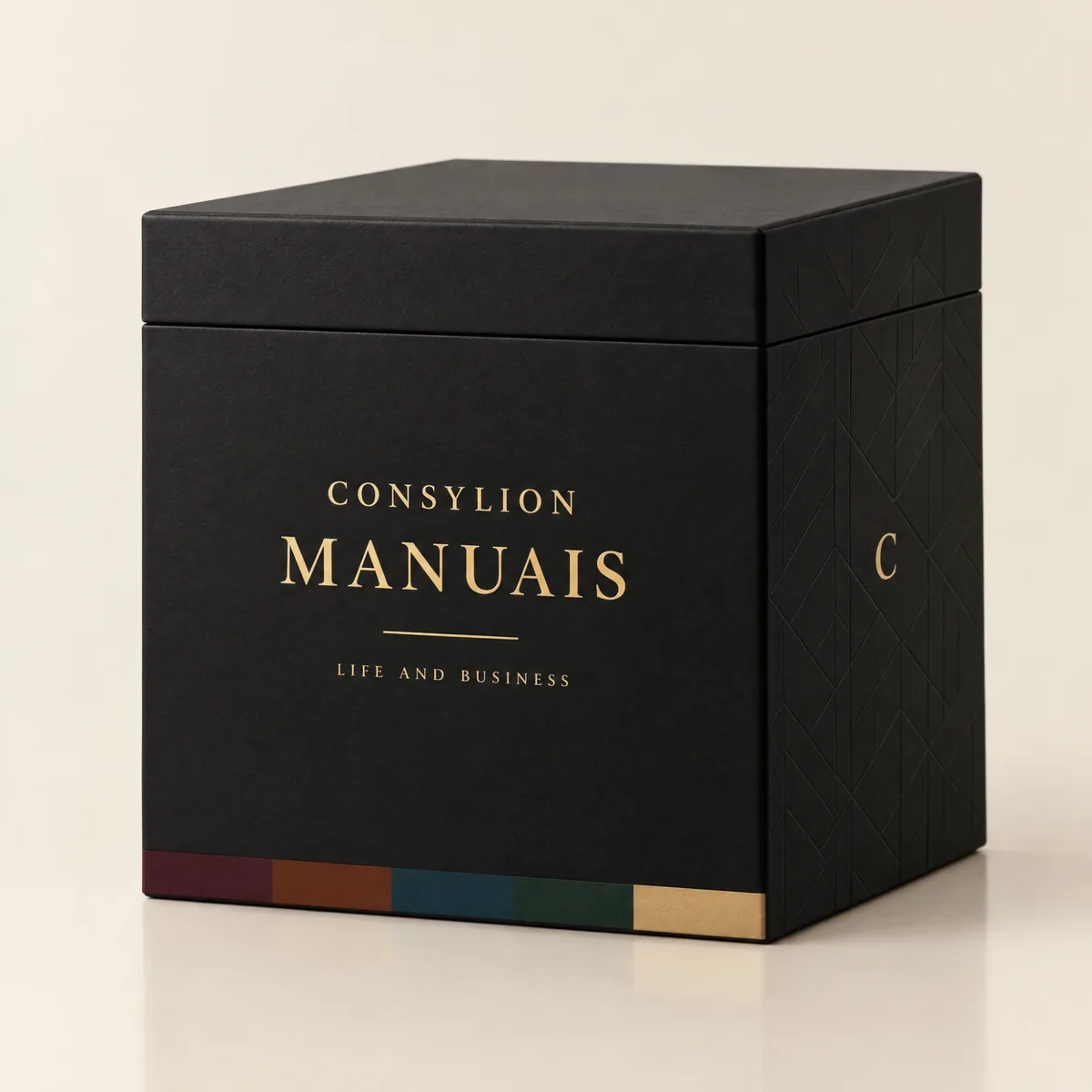
CONSYLION HANDBOOK SERIES
The 6 departments of your business, for less than the price of 8 single handbooks.
This handbook solves today's problem. The Series solves the next one, and the one after that, with nothing more to pay.
- 100 handbooks with 2,403 ready-made tools, to read on screen and download as PDFs
- 100 spreadsheets for Excel and Google Sheets
- 6 business areas
- Lifetime access, unlocked once payment is confirmed
One-time payment of $197.00. The order form shows the final amount, with any taxes for your country, before you pay.
Digital delivery: PDF handbook, spreadsheet and access on the Consylion platform.
14-day money-back guarantee: if it isn't what you expected, request a full refund within 14 days of purchase.
Your order is processed by Digistore24, our authorized reseller. By purchasing, you accept the terms of use and purchase · refund policy.
Finance · Nº 53
Make getting paid the predictable part
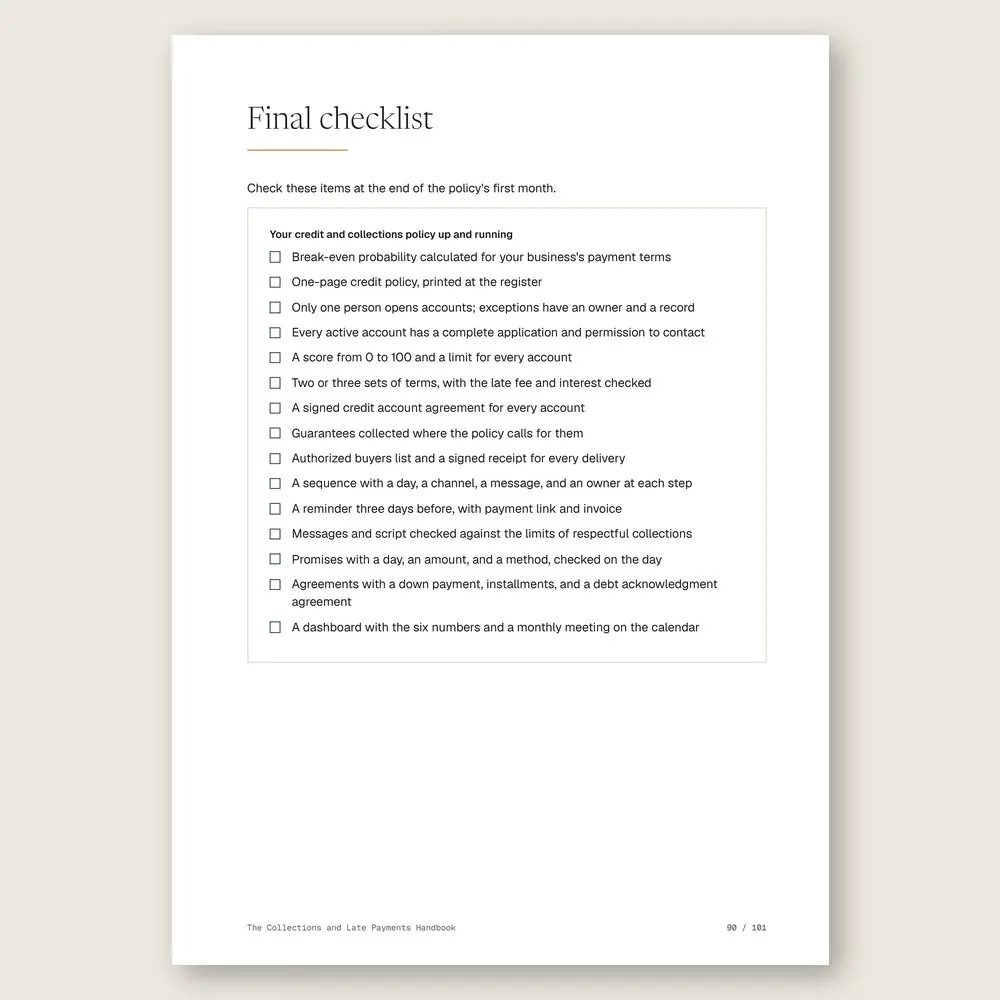
Good collections aren't about being tough. They're about being predictable: the customer knows what was agreed, when to pay, and what happens if they don't. This handbook gives you the policy, the sequence, the scripts, and the spreadsheet to run it that way, starting this month.
See all 100 handbooks · $197.00
One-time payment of $29.00. The order form shows the final amount, with any taxes for your country, before you pay.
Digital delivery: PDF handbook, spreadsheet and access on the Consylion platform.
14-day money-back guarantee: if it isn't what you expected, request a full refund within 14 days of purchase.
Your order is processed by Digistore24, our authorized reseller. By purchasing, you accept the terms of use and purchase · refund policy.