The Owner's Finances Handbook
Finance · Nº 14
The Owner's Finances Handbook
Keep Personal and Business Money Apart, Set Your Owner's Pay, and Build an Emergency Fund
Your business pays for the groceries. So how much do you actually make?
24 tools, a spreadsheet that does the math, and one family worked through start to finish, so you can split household and business money and pay yourself on a fixed date.
You get 24 tools to split household and business money, set your owner's pay and a fixed monthly draw, organize the family budget, build an emergency fund, and look after your net worth. Plus a spreadsheet with 5 working tabs, filled in with the example.
A book explains the method. This handbook puts it to work: the tool, a worked example, and a spreadsheet with your numbers.
One-time payment of $29.00. The order form shows the final amount, with any taxes for your country, before you pay.
Digital delivery: PDF handbook, spreadsheet and access on the Consylion platform.
14-day money-back guarantee: if it isn't what you expected, request a full refund within 14 days of purchase.
Your order is processed by Digistore24, our authorized reseller. By purchasing, you accept the terms of use and purchase · refund policy.
The school tuition came out of the business account again. Last week you put a supplier's bill on your personal card because the business was short on cash. Every few days you move money to yourself, whenever the household needs it. Your accountant says the business is profitable. But if someone asked how much you make a month, you'd say "it depends." There's no emergency fund. And almost everything you own is tied up in the business.
THE SPREADSHEET
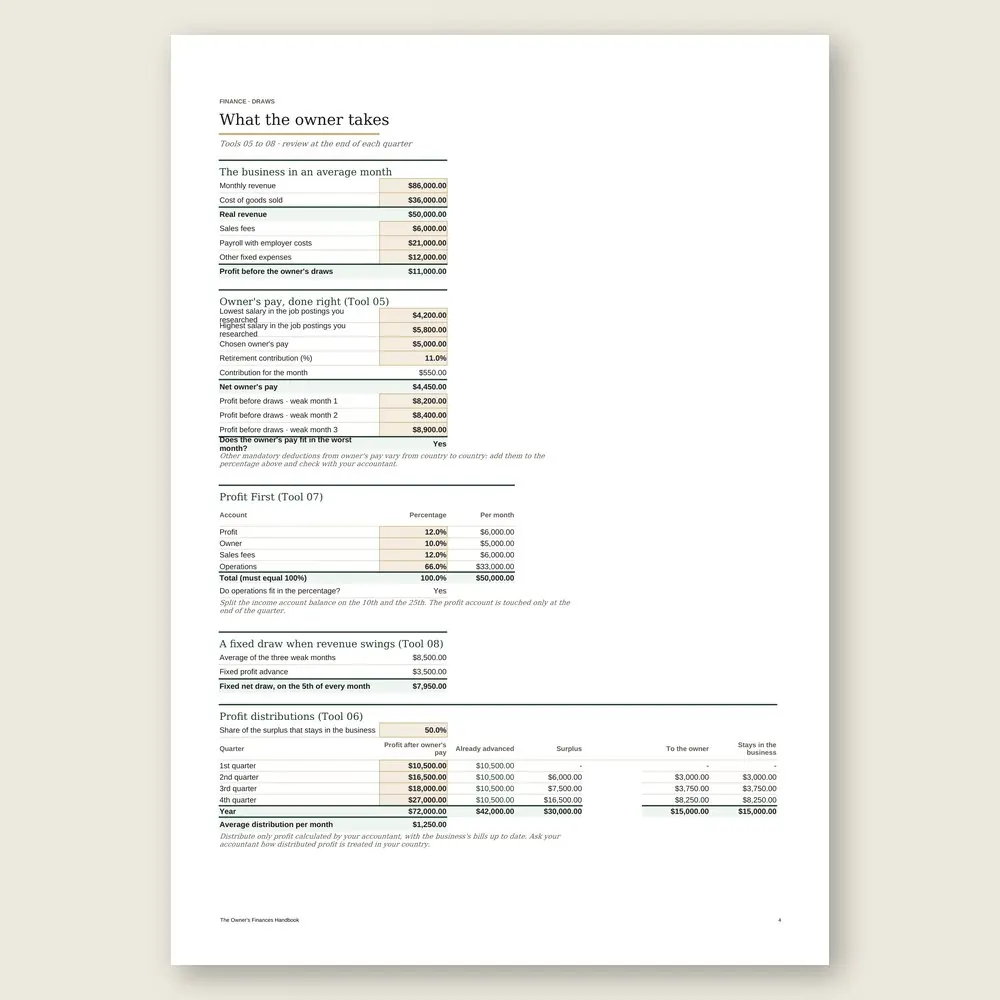
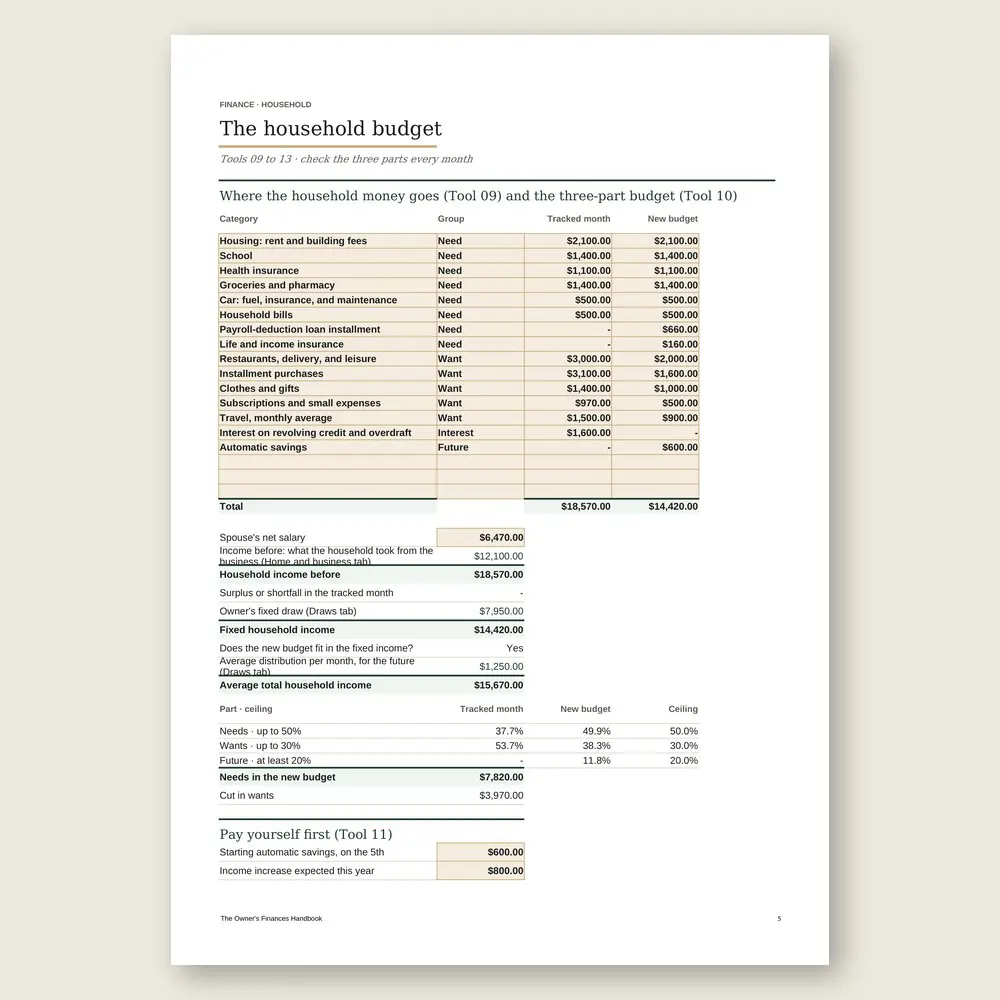
Owner's finances spreadsheet
Use the completed example as a reference and enter your business data in the marked fields. Check the instructions and the calculations before you make a decision.
SOUND FAMILIAR?
Three situations this handbook solves
The 5th of the month
Your fixed draw, owner's pay plus a profit advance, lands in your personal account on the same day as always. No more transfers whenever the household runs short. Any profit above the advance is settled each quarter, once your accountant closes the books.
The bank sends the loan renewal
Before you sign, you check how much of the family's assets the business's debt can reach. Then you walk in with your card sales statement, offer those receivables as the main collateral, and ask to limit what you sign for personally to part of the debt.
First Sunday of the month
You and your spouse sit down for 40 minutes with a fixed agenda: the three parts of the budget, the draw and the profit distribution, the emergency fund and debts, and the month's decisions.
INSIDE
What you'll find in each tool
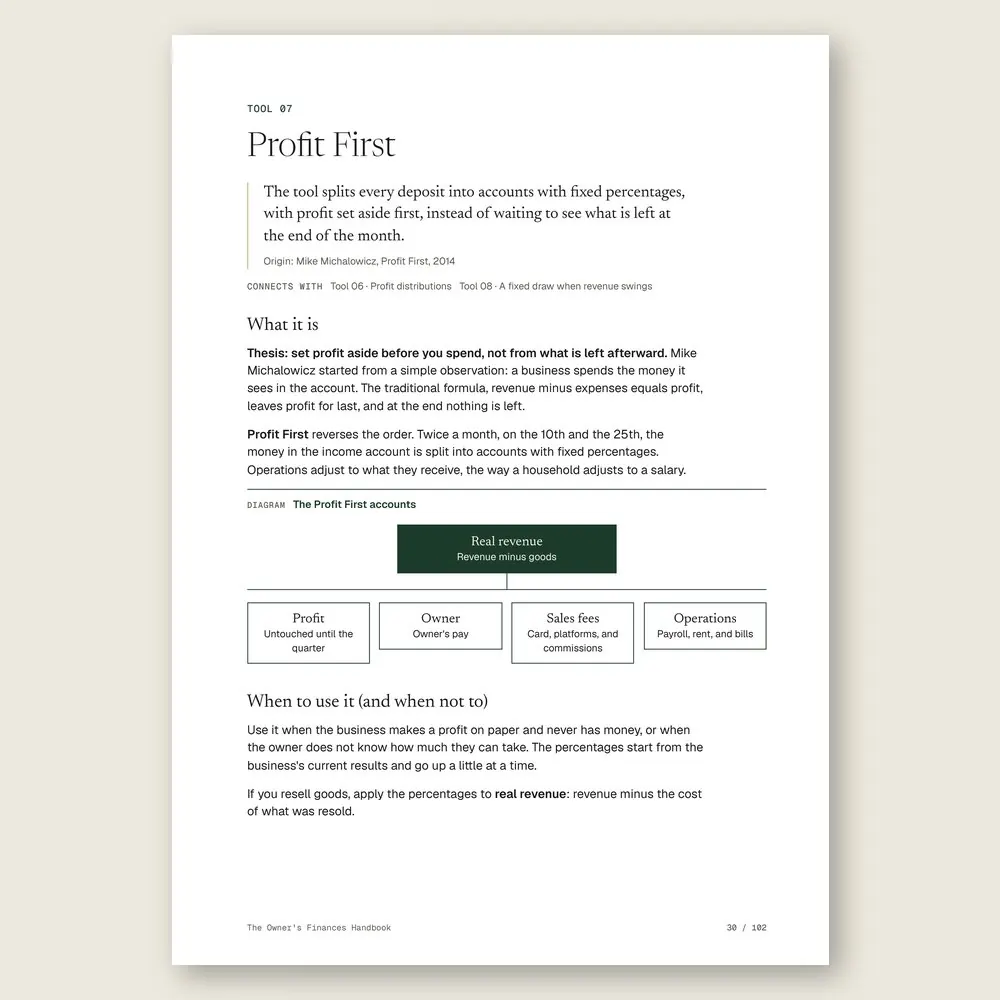
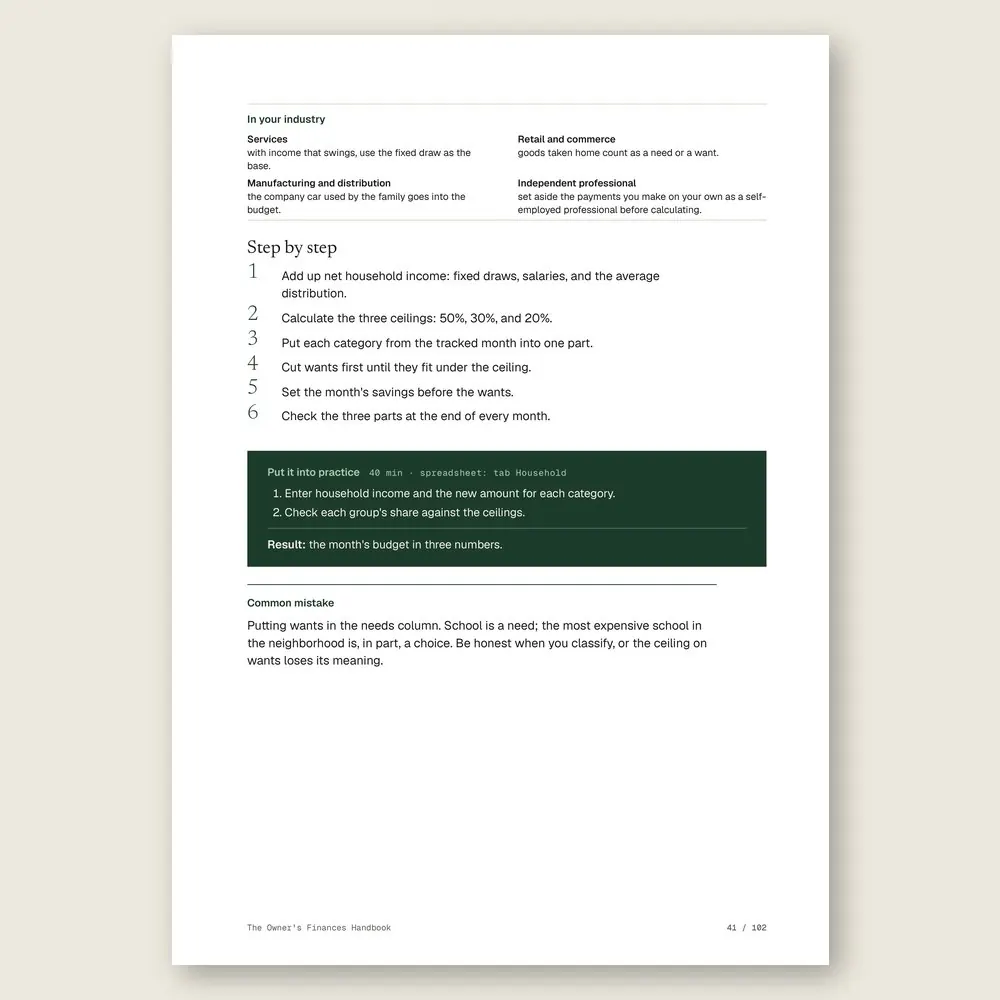
Five parts, in the order the money moves. Draw the line between home and business. Decide what you take: owner's pay, profit distributions, and a fixed draw. Organize the household budget and pay down debt in the right order. Protect the family with an emergency fund, insurance, and a retirement plan. Then look after your net worth with a yearly balance sheet and a monthly check. Every tool has a step by step, a worked example, and an exercise.
WHAT YOU GET
Everything included in your purchase
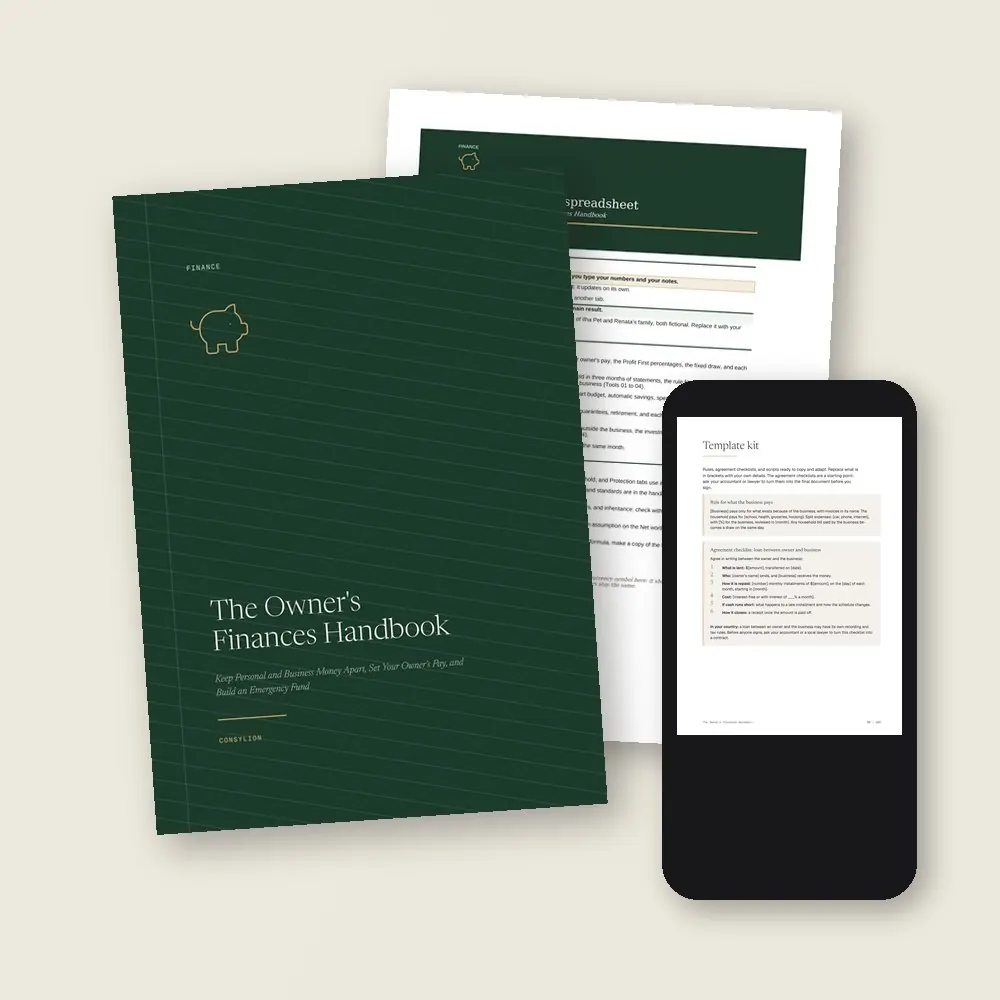
- The Owner's Finances Handbook in PDF: 24 tools, each with a step by step, a worked example, and an exercise
- The owner's finances spreadsheet in Excel and Google Sheets, with 5 working tabs, filled in with the example family
- The Template kit: 12 ready-made texts, including a loan agreement between owner and business, the couple's money talk agenda, and a letter of instructions to the family
- 2 worksheets to fill in (the monthly home and business check and the owner's balance sheet) and a 30-day plan, one week per stage
- Access to your handbook on the Consylion platform
Full table of contents
The 24 tools, in the order you'll use them
Part 1 · Part 1 · The line between home and business
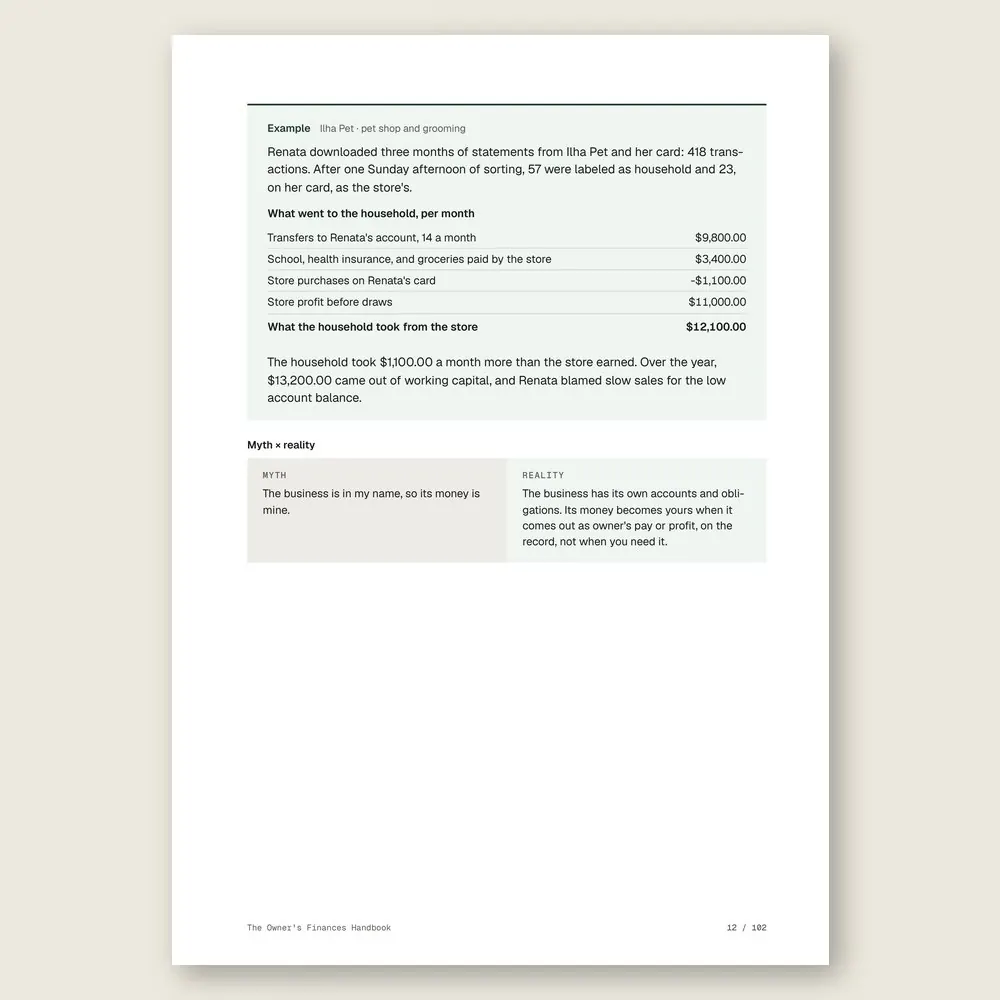
- 01Where the money gets mixedThree months of statements that show how much the household really takes from the business
- 02Two accounts, two livesSeparate accounts and cards, each with its own rule, switched over in 30 days
- 03What the business pays for and what it does notA written rule for the car, the phone, and every other borderline expense
- 04Loans between you and the businessMoney that goes back and forth, on paper, with installments and a date
Part 2 · Part 2 · What the owner takes
- 05Owner's pay, done rightA salary for your work, set at the market rate and checked against the weak months
- 06Profit distributionsHow much profit comes out, when, and how much stays in the business
- 07Profit FirstSet profit aside when the money comes in instead of waiting for leftovers
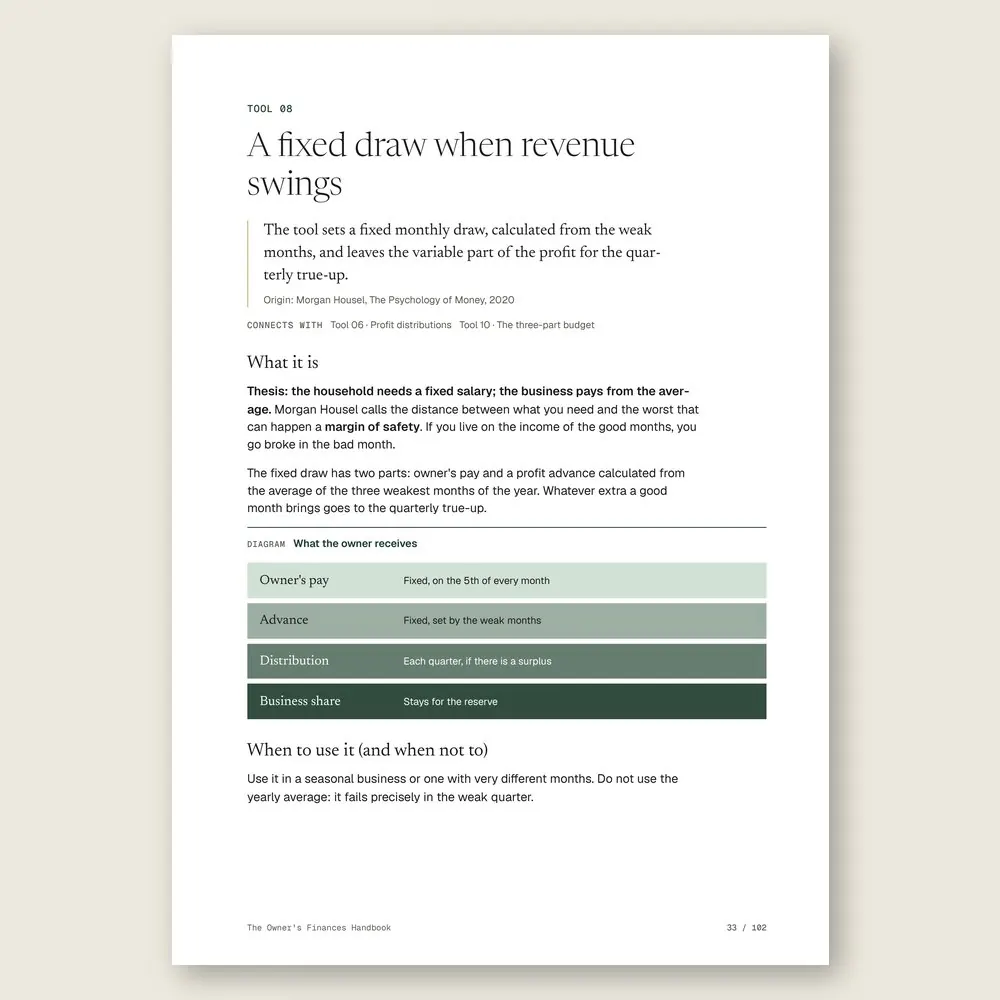
- 08A fixed draw when revenue swingsOne amount the household can count on every month, calculated from the weak months
Part 3 · Part 3 · The household budget
- 09Where the household money goesThirty days of tracking that replace guesswork with real numbers
- 10The three-part budgetNeeds, wants, and the future, with a ceiling for each and only three numbers to watch
- 11Pay yourself firstSavings that leave the account on payday, before anything else does
- 12Spending that grows with incomeA rule that keeps the next raise from disappearing into lifestyle creep
- 13Debts in the right orderExpensive interest first, and how to swap costly debt for cheaper debt
Part 4 · Part 4 · Protection
- 14The owner's emergency fundHow many months to save when your income varies, and where to keep it
- 15Insurance that makes senseLife, income, and property: what to insure and for how much
- 16Personal guarantees and your homeFind out how far the business's debt can reach your family, and shrink it
- 17The owner's retirementPublic retirement as the floor, and the monthly amount that fills the gap
- 18Money as a coupleA monthly money talk with your spouse, with a fixed agenda
Part 5 · Part 5 · Net worth and the future
- 19The owner's balance sheetWhat the family owns, what it owes, and what it's really worth, once a year
- 20Not everything inside the businessHow much of your net worth depends on the business, and a target for the share outside it
- 21Your first investment outside the businessThe right order: emergency fund, retirement, then goals
- 22Succession and inheritanceWhat your family needs to know and have on hand if you're gone
- 23Buy or rentThe math on owning a home, including the cost of money sitting idle
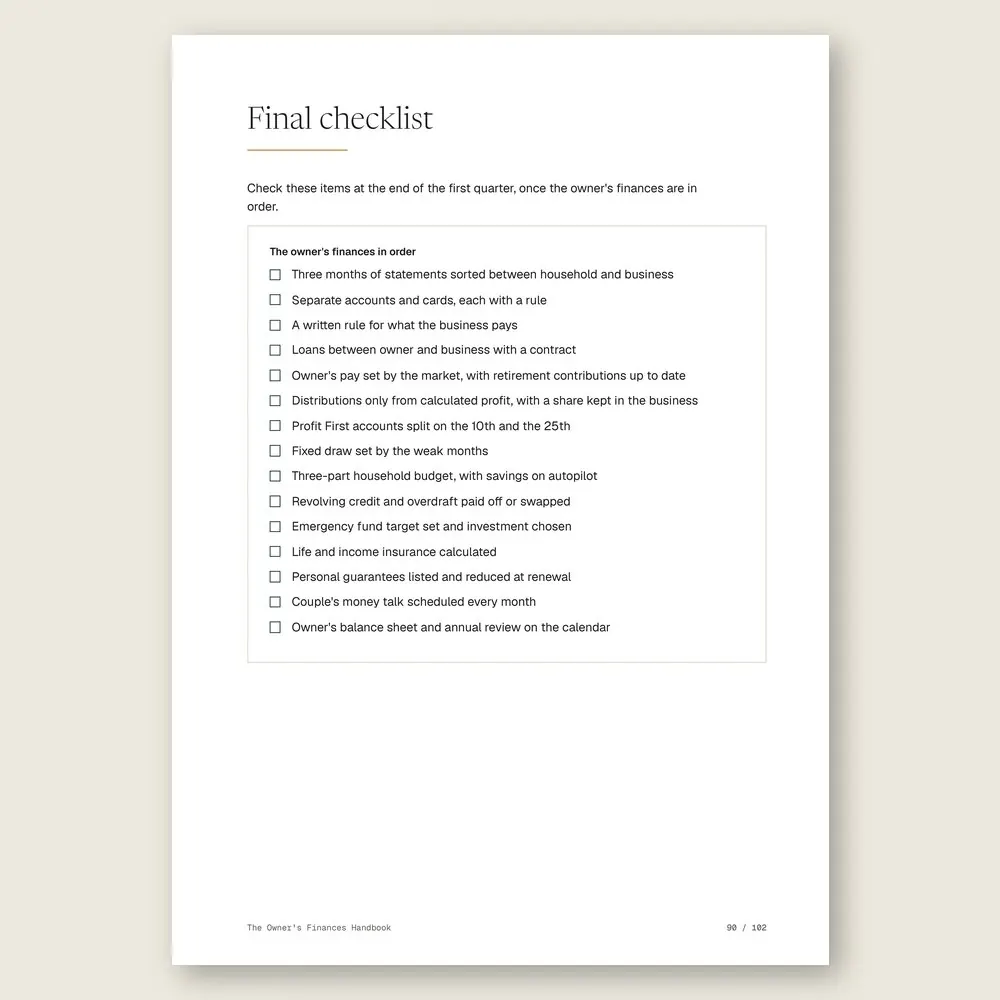
- 24The owner's financial reviewOne hour a month and one day a year for your own money
Who it's for
It's for you if
- Household and business money run through the same account, and you can't say how much you really make
- You take money out of the business whenever you need it, with no set amount and no set date
- Your income swings with sales and you want one fixed draw the household can count on
- You have no personal emergency fund and you're paying interest on a credit card or an overdraft
- Almost everything you own is tied up in the business, and you've signed personally for its loans
It's not for you if
- You need to organize the business's cash flow, P&L, and reserve. That's The Cash Flow and Profit Handbook
- You want help picking stocks, funds, or crypto. This handbook only sets the order of your first investments outside the business
- You need a succession plan with a holding company and several heirs. That's work for an attorney and an accountant
- You're hoping for a shortcut to wealth. This handbook organizes the money you already have
Frequently asked questions
I run a one-person business. Is this for me?
Yes. A one-person business still needs a separate account, owner's pay, and a fixed draw. Every tool shows how it applies to services, retail, manufacturing, and independent professionals, and flags where local rules differ so you know what to check with your accountant.
Do I need to know accounting or investing?
No. It's written for beginners, and the spreadsheet does the math: you type your numbers into the input cells and the rest updates. The handbook doesn't pick stocks or funds. It sets the order of your first investments outside the business and sends you to a certified professional for the rest.
I have a business partner. Does it still work?
Yes. Each partner who works in the business gets owner's pay for that work, and profit is split by each partner's stake, with the same rule for everyone. Tools 05 and 06 walk you through it.
My spouse doesn't want to talk about money. Now what?
Start with the numbers, not with anyone's spending. Show the business loan your spouse co-signed and the emergency fund that isn't there yet. The conversation changes when the risk belongs to both of you. Tools 16 and 18 walk you through it, and the Template kit has the agenda.
Should I pay off debt or build the emergency fund first?
Expensive debt first, like credit card balances and overdraft. Then the emergency fund. Once the fund is in place, the expensive debt has a harder time coming back. Tools 13 and 14 set the order.
How much time does this take?
About 2 hours and 24 minutes of reading, or 6 minutes per tool, plus the exercises. After that, the routine is one hour a month and one day a year for your own money, and a 40-minute money talk with your spouse once a month.
What do I get, and in what formats?
Each handbook is a PDF of about 100 pages with 24 to 27 tools. Every tool has step-by-step instructions and a worked example. You also get the handbook's spreadsheet in Excel (.xlsx), which opens in Google Sheets too, with the example already filled in. The message, policy, and clause templates are in the Template Kit inside the PDF, ready to copy and adapt. Read it in the member area or download the files.
How do I know if it fits my business?
Each handbook's page shows the problem it solves, who it is for and who it is not for, the full table of contents, sample pages, and the company used in the examples. The examples come from small businesses in several industries, with illustrative numbers. If it is not a fit, you can ask for a full refund within 14 days of your purchase, as described in the Refund Policy.
What is the difference between a handbook, an area set, and the Series?
A handbook solves one problem. An area set brings together every handbook and spreadsheet in one of the 6 areas, for less than the price of 5 single handbooks. The Consylion Handbook Series brings together all 100 handbooks and 100 spreadsheets, for less than the price of 8 single handbooks, and includes the next handbooks in the Series. Products outside the Series, from Consylion Life or Consylion Business, have their own price. They are sold separately and are not part of an area set or the Series.
Do I need to read everything before I start?
No. Each tool works on its own. Open the table of contents, pick the tool for today's problem, and start there. You can also read it cover to cover.
Do I need to know Excel?
The basics are enough: open the file and fill in the marked fields. The formulas are already built, and the handbook's example is filled in for reference.
How do I pay, and when do I get access?
By card or bank transfer, as a one-time payment with no subscription. Once your payment is confirmed, you get access to the member area by email. Approved card payments are confirmed right away. Bank transfers are confirmed when the funds clear. If access does not arrive within 24 hours of confirmation, check your spam folder and write to team@consylion.org.
How long do I have access, and how can I use the files?
Access does not expire, and you can download the files for offline use. The license is individual. You may read the handbooks, print them for your own use, and fill in and adapt the spreadsheet and templates with your company's data. If you are a consultant, accountant, or manager, you may apply the tools with your clients and deliver the result of your work, not the files. You may not share, resell, or distribute the files or the access.
How do support and refunds work?
Support is by email at team@consylion.org, on business days, with a reply within 5 business days. It covers questions about access, files, and payment. It does not include consulting or advice on applying the material to your case. You can cancel within 14 days of your purchase, without giving a reason, and get the full amount back through the payment method you used. Send the request to the same email. The details are in the Refund Policy.

CONSYLION HANDBOOK SERIES
The 6 departments of your business, for less than the price of 8 single handbooks.
This handbook solves today's problem. The Series solves the next one, and the one after that, with nothing more to pay.
- 100 handbooks with 2,403 ready-made tools, to read on screen and download as PDFs
- 100 spreadsheets for Excel and Google Sheets
- 6 business areas
- Lifetime access, unlocked once payment is confirmed
One-time payment of $197.00. The order form shows the final amount, with any taxes for your country, before you pay.
Digital delivery: PDF handbook, spreadsheet and access on the Consylion platform.
14-day money-back guarantee: if it isn't what you expected, request a full refund within 14 days of purchase.
Your order is processed by Digistore24, our authorized reseller. By purchasing, you accept the terms of use and purchase · refund policy.
Finance · Nº 14
Know how much you really make
The business has its money. The household has its own. This handbook gives you the tools, the spreadsheet, and a worked example to draw that line, pay yourself on a fixed date, and start the family's emergency fund. What you do with it from there is up to you.
See all 100 handbooks · $197.00
One-time payment of $29.00. The order form shows the final amount, with any taxes for your country, before you pay.
Digital delivery: PDF handbook, spreadsheet and access on the Consylion platform.
14-day money-back guarantee: if it isn't what you expected, request a full refund within 14 days of purchase.
Your order is processed by Digistore24, our authorized reseller. By purchasing, you accept the terms of use and purchase · refund policy.